
Rebecca Phillips is the CACFP Coordinator for Northeast Iowa Community Action Corporation (NEICAC). As a community action nonprofit, NEICAC provides services to support people through all stages of life, including CACFP. As a CACFP sponsor, NEICAC supports 35 family child care homes and 10 Head Start classrooms that serve over 700 children.
Read MoreApril 3, 2026 Celebrating You: Simple Ideas, Big Impact for Child Care Providers Every day, child care providers show up with care, creativity and commitment; shaping healthy habits and brighter futures for the children they serve. This Provider Appreciation Month, and in honor of the 40th anniversary of the National CACFP Association, we’re taking time…
Read More
How are grains measured and credited in the CACFP?
Read More
NCA leaders brought the CACFP story to Las Vegas radio ahead of the 40th annual National Child Nutrition Conference.
Read More
Senta Hester is Executive Director of Our Daily Bread CACFP, a CACFP sponsoring organization in Tennessee and Kentucky. Our Daily Breads sponsored sites serve nutritious meals to 23,500 children and adults across the two states. Learn more about their work!
Read More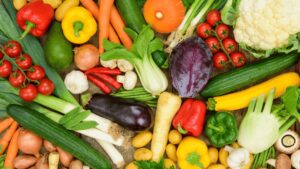
How are vegetables measured and credited in the CACFP?
Read More
NCA leaders brought the CACFP story to Las Vegas radio ahead of the 40th annual National Child Nutrition Conference.
Read More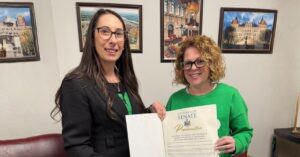
This March, National CACFP Week earned recognition at every level of government, from Congress to state capitals and local districts. The annual education and information campaign, sponsored by the National CACFP Association (NCA), is observed each year during the third week of March and highlights the vital role the USDA’s Child and Adult Care Food Program (CACFP) plays in combating hunger and promoting nutrition.
Read More
This year’s conference just got even more valuable for registered dietitians and dietetic technicians, registered. The 40th Annual National Child Nutrition Conference has been approved for 24[MN3.1][IR3.2].5 CPEUs in accordance with the Commission on Dietetic Registration’s CPEU Prior Approval Program.
Read More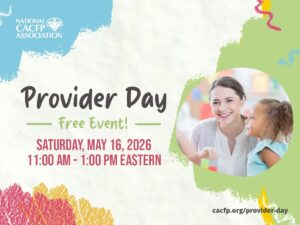
The National CACFP Association will host Provider Day, a free virtual event for child care providers, on Saturday, May 16, 2026. The event takes place during Provider Appreciation Month and during the association’s 40th anniversary year.
Read More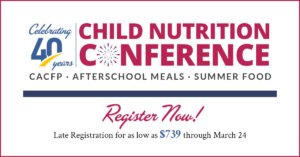
Late registration is now open for the 2026 National Child Nutrition Conference (NCNC26), the largest annual gathering of professionals dedicated to supporting the Child and Adult Care Food Program and the Summer Food Service Program. Late registration will be available through March 24, 2026. The conference will take place April 13–17, 2026, in Las Vegas, Nevada.
Read More
The National CACFP Association proudly announces the general session speakers for the 40th annual National Child Nutrition Conference (NCNC), bringing national leadership and powerful inspiration to this milestone event. The conference will take place April 13-17, 2026, in Las Vegas, Nevada, convening child and adult nutrition professionals from across the country.
Read More
Earlier this month, a bill was introduced to the House of Representatives to extend the additional 10 cent reimbursement in the CACFP through school year 2023-2024. If this bill is passed, the additional 10 cent reimbursement would be implemented through June 30, 2024.
Read More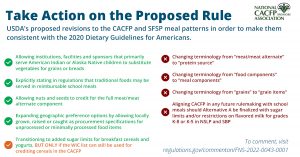
Based on feedback from our members, NCA has developed model comments to help you provide feedback to USDA about the Proposed Rule regarding changes to meal patterns to be consistent with the 2020 DGAs.
Read More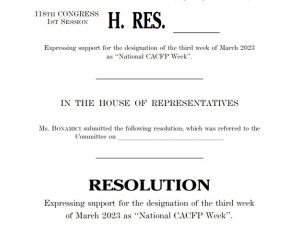
Today, March 14, 2023, Congresswoman Suzanne Bonamici (D-OR), along with cosponsors, introduced a resolution to designate the third week of March 2023 as National CACFP Week.
Read More
In September 2022, FNS published the Final Rule: Streamlining Program Requirements and Improving Integrity in the SFSP. Compliance with the provisions of the rule must begin by May 1, 2023. The USDA released a memo to provide guidance for state agencies and program operators on SFSP performance standards, budgets, and management plans which were aligned with other child nutrition programs through the final rule.
Read More
Summer EBT will provide EBT benefits on an ongoing basis to low-income children during the summer months to ensure continued access to meals and snacks when school is not in session. For 2024, benefits are an amount equal to $40 per month per eligible child during the summer operational period.
Read More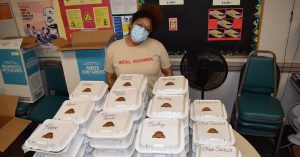
The Consolidated Appropriations Act, 2023, established a permanent non-congregate meal service option for rural areas with no congregate meal service available. This memorandum provides guidance on the administration and operation of non-congregate meal service in rural areas during summer 2023 for the SFSP.
Read More
Behind every CACFP meal is a system of oversight designed to maintain public trust and protect the people the program serves. Sponsoring organizations ensure compliance, accountability and continued access to nutritious meals while providing ongoing technical assistance. Here are resources that explain how program integrity is upheld in the CACFP.
Read More
Exciting news! Head Start programs have an opportunity to access one-time supplemental funds to support nutrition services and healthy eating for enrolled children and families. You can use this funding for staff training on resources and educational opportunities to help your program improve outcomes for children and families and align with USDA requirements – like the CACFP!
Read More
The Child and Adult Care Food Program has new creditable foods listed on the USDA Food Buying Guide! If you are new to the FBG, this interactive tool allows for easy display, search, and navigation of food yield information. In addition, users can compare yield information, create a favorite foods list, and access tools, such as the Recipe Analysis Workbook (RAW) and the Product Formulation Statement Workbook.
Read More
The Child and Adult Care Food Program community asked for more Spanish resources to be available on the National CACFP Sponsors Association website and we heard you! Available now in Spanish are more resources to help sponsors and providers with meal pattern requirements, best practices, and so much more!
Read More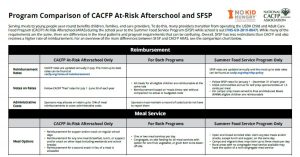
Serving meals to young people year-round benefits children, families, and care providers. To do this, many providers transition from operating the USDA Child and Adult Care Food Program (CACFP) At-Risk Afterschool (ARAS) during the school year to the Summer Food Service Program (SFSP) while school is out. For an overview of the main differences between SFSP and CACFP ARAS, see the comparison chart below.
Read More
NCA understands that the end of flexibilities will cause challenges for many CACFP sponsors and providers and we commend your continued commitment to providing nutritious meals and snacks to the children or adults in your care. In preparation for the end of the additional reimbursement, we have collected the following resources to help you successfully provide meals even if your available budget decreases.
Read More
How are grains measured and credited in the CACFP?
Read More
How are vegetables measured and credited in the CACFP?
Read More
How are fruits measured and credited in the CACFP?
Read More
How is fluid milk measured and credited in the CACFP?
Read More
Are all flavored popcorns creditable in the CACFP?
Read More
Do you need different volumes to equal one ounce equivalent based on the type of breakfast cereal?
Read More
Behind every CACFP meal is a system of oversight designed to maintain public trust and protect the people the program serves. Sponsoring organizations ensure compliance, accountability and continued access to nutritious meals while providing ongoing technical assistance. Here are resources that explain how program integrity is upheld in the CACFP.
Read More
Exciting news! Head Start programs have an opportunity to access one-time supplemental funds to support nutrition services and healthy eating for enrolled children and families. You can use this funding for staff training on resources and educational opportunities to help your program improve outcomes for children and families and align with USDA requirements – like the CACFP!
Read More
The Child and Adult Care Food Program has new creditable foods listed on the USDA Food Buying Guide! If you are new to the FBG, this interactive tool allows for easy display, search, and navigation of food yield information. In addition, users can compare yield information, create a favorite foods list, and access tools, such as the Recipe Analysis Workbook (RAW) and the Product Formulation Statement Workbook.
Read More
The Child and Adult Care Food Program community asked for more Spanish resources to be available on the National CACFP Sponsors Association website and we heard you! Available now in Spanish are more resources to help sponsors and providers with meal pattern requirements, best practices, and so much more!
Read More
Serving meals to young people year-round benefits children, families, and care providers. To do this, many providers transition from operating the USDA Child and Adult Care Food Program (CACFP) At-Risk Afterschool (ARAS) during the school year to the Summer Food Service Program (SFSP) while school is out. For an overview of the main differences between SFSP and CACFP ARAS, see the comparison chart below.
Read More
NCA understands that the end of flexibilities will cause challenges for many CACFP sponsors and providers and we commend your continued commitment to providing nutritious meals and snacks to the children or adults in your care. In preparation for the end of the additional reimbursement, we have collected the following resources to help you successfully provide meals even if your available budget decreases.
Read More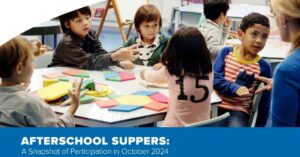
The Food Research and Action Center (FRAC) released their Afterschool Supper report that snapshots participation in October 2024. They found that afterschool supper participation has increased and that CACFP represents 50% of the daily participation.
Read More
The Stanford Center on Early Childhood released a RAPID report that looks at how issues of food insecurity and hunger are affecting adults who provide care for young children. Their key finding: hunger is on the rise among child care providers.
Read More
USDA released their second report on the Study of Nutrition and Activity in Child Care Settings (SNACS-II), which follow their first in 2022. SNACS-II uses data from program year 2022-23 to assess how well children’s diets and CACFP meals align with the Dietary Guidelines for Americans.
Read More
A recent study by our partners at Child Care Aware® of America reveals that parents across the nation are struggling to find affordable, high-quality child care. The survey shows that parents are piecing together multiple care arrangements and facing challenges balancing work and caregiving.
Read More
The CDC’s 2025 Early Childhood Nutrition Report gives us a big-picture look at how young children in the U.S. are eating and growing. It focuses on kids from birth to age 5 and shares important facts about breastfeeding, starting solid foods, eating healthy and how states support good nutrition.
Read More
The “Characteristics of Emergency Shelters Participating in the CACFP” study by USDA seeks to better understand the characteristics of CACFP emergency shelters, who they serve, how CACFP fits into their operations, and their challenges with CACFP. The study was conducted in 2023 and collected data from 242 emergency shelters that participate in CACFP in Fiscal Year 2023.
Read More
Rebecca Phillips is the CACFP Coordinator for Northeast Iowa Community Action Corporation (NEICAC). As a community action nonprofit, NEICAC provides services to support people through all stages of life, including CACFP. As a CACFP sponsor, NEICAC supports 35 family child care homes and 10 Head Start classrooms that serve over 700 children.
Read More
Senta Hester is Executive Director of Our Daily Bread CACFP, a CACFP sponsoring organization in Tennessee and Kentucky. Our Daily Breads sponsored sites serve nutritious meals to 23,500 children and adults across the two states. Learn more about their work!
Read More
Sponsor of At-Risk Afterschool, Child Care Centers and Family Child Care Homes March 23, 2026 Sloane Pittman is CEO of Child Nutrition Program (CNP), a CACFP sponsoring organization in North Carolina. Sloane is the third generation of her family to lead CNP. Sloane’s grandmother was an active advocate for women throughout the ’50s and the…
Read More
Sponsor of Family Child Care Homes and Child Care Centers March 16, 2026 Lisa Lyons is the CACFP Director for The Planning Council, a human services organization that provides various services for children and families. Some of their programs include assistance at homeless shelters, respite for families with a special needs child and sponsorship of…
Read More
Lutheran Services Florida sponsors 24 affiliated Head Start and Early Head Start sites, 396 family day care homes and four emergency shelters. Collectively, these programs serve nutritious meals and snacks to over 6,000 children in their care. Read more about the work of this NCA member.
Read More
NWAFCCA sponsors 47 family child care homes that serve nutritious meals and snacks to over 600 children in Northwest Arkansas. Learn more about the great work of this NCA member!
Read More