
3.9 million children served healthy meals & snacks daily
Imagine it is lunchtime at your child care center. The room is filled with chatter and laughter as children dig into colorful, delicious, nutritious meals made with care. Parents/guardians pick up their kids knowing they have been well fed - not just full, but truly nourished.
You pour your heart into providing high-quality care, but covering the cost of healthy meals while keeping costs low for hard-working families can be challenging.
That’s where the Child and Adult Care Food Program (CACFP) comes in.
The CACFP is federally funded, state-administered, and designed to support child care programs in providing nutritious meals and promoting healthy development. Participating in the CACFP strengthens your center’s programming and supports families by ensuring children receive balanced meals during the day. Through the CACFP, child care centers across the country can receive reimbursement for breakfasts, lunches, and snacks served to children in eligible settings. This program helps you stretch your resources, provide high-quality nutrition, and give children the nourishment they need to grow, learn, and thrive.
Whether you operate a private or public nonprofit child care center, outside of school-hours care center, Head Start program, or other institutions which is licensed or approved to provide child care services, the CACFP for child care can help you make every day count for the children in your care.
Why Does the CACFP for Child Care Centers Matter?
Millions of children rely on meals served in child care centers to meet their daily nutritional needs. Many families depend on these centers to provide consistent, healthy meals while parents work or attend school. By participating in the CACFP, child care centers can help ensure children receive the nourishment they need to grow, learn and thrive.
Where is there room for growth?
With millions of children eligible but not yet reached, expanding CACFP participation in child care centers is both a need and an opportunity. Your center can help fill this critical gap and support the well-being of children in your community.
What does research show?
- Hunger is linked to difficulty focusing, lower test scores and chronic absenteeism.
- Children experiencing food insecurity are more likely to struggle with behavior, stress and social interaction.
- Programs offering nutritious meals show increased enrollment, stronger engagement and better outcomes.
Child care centers provide structured care and a safe, nurturing environment. By serving meals that meet USDA standards, centers can support children’s development while helping families manage the cost of healthy food.
What are the benefits of serving meals through CACFP?
- Combat Food Insecurity: Ensure children in your care receive nutritious meals and snacks, supporting families who may struggle to provide consistent meals.
- Support Healthy Development: Meals follow CACFP meal pattern standards, promoting growth, learning and lifelong healthy habits.
- Improve Program Appeal: Offering meals can make your center more attractive to families and boost enrollment.
- Strengthen Program Support: Reimbursement helps offset food costs and allows centers to provide higher-quality meals and services.
- Support Working Families: Families rely on child care centers for both care and meals.
- Increase Community Impact: By serving CACFP meals, centers contribute to the overall well-being of their communities and help ensure children have consistent access to nutrition.
Child Care Center Overview
Who can participate?
Child care centers eligible to participate in the CACFP include a wide range of facilities that provide care and meals to children. To qualify, centers must meet state or local licensing or approval requirements and be authorized to operate under CACFP guidelines. Participation allows these centers to receive reimbursements for serving nutritious meals and snacks to enrolled children, supporting their health and development.
What are the site eligibility requirements?
Child care centers that meet the requirements below are eligible to receive reimbursement for meals and snacks.
To participate in the CACFP as a child care center, a program must:
- Be licensed or approved by state/local authorities,
- Provide regular, non-residential child care services, and
- Serve meals/snacks to enrolled children
What organizations are eligible?
Child care centers must be a public or private nonprofit nonresidential centeror a qualified for-profit center. The center must be financially and administratively capable of operating the program
For-profit child care centers can participate in the Child and Adult Care Food Program (CACFP) if they receive compensation from funds granted to states under Title XX. These centers are often called "Proprietary Title XX Centers." To qualify, a center must receive Title XX funding for at least 25% of its enrolled children or licensed capacity, whichever is less.
Examples of Eligible Organizations:
- Nonprofit Early Head Start/Head Start Centers Example: A nonprofit agency running multiple Head Start sites across a county.
- Faith-Based Child Care Centers Example: A church-run preschool that offers full-day care.
- Community-Based Nonprofits Example: A YMCA that provides day care programming.
- School District-Operated Preschools Example: A public school’s Pre-K program that operates separately from K–12 and qualifies for CACFP.
- University-Affiliated Child Care Centers Example: A campus child care center for faculty, staff, and students’ children.
Is there required training?
Annual training is required for staff operating the CACFP. Training includes meal pattern information, record-keeping requirements and civil rights compliance.
Child Care Centers Meal Service
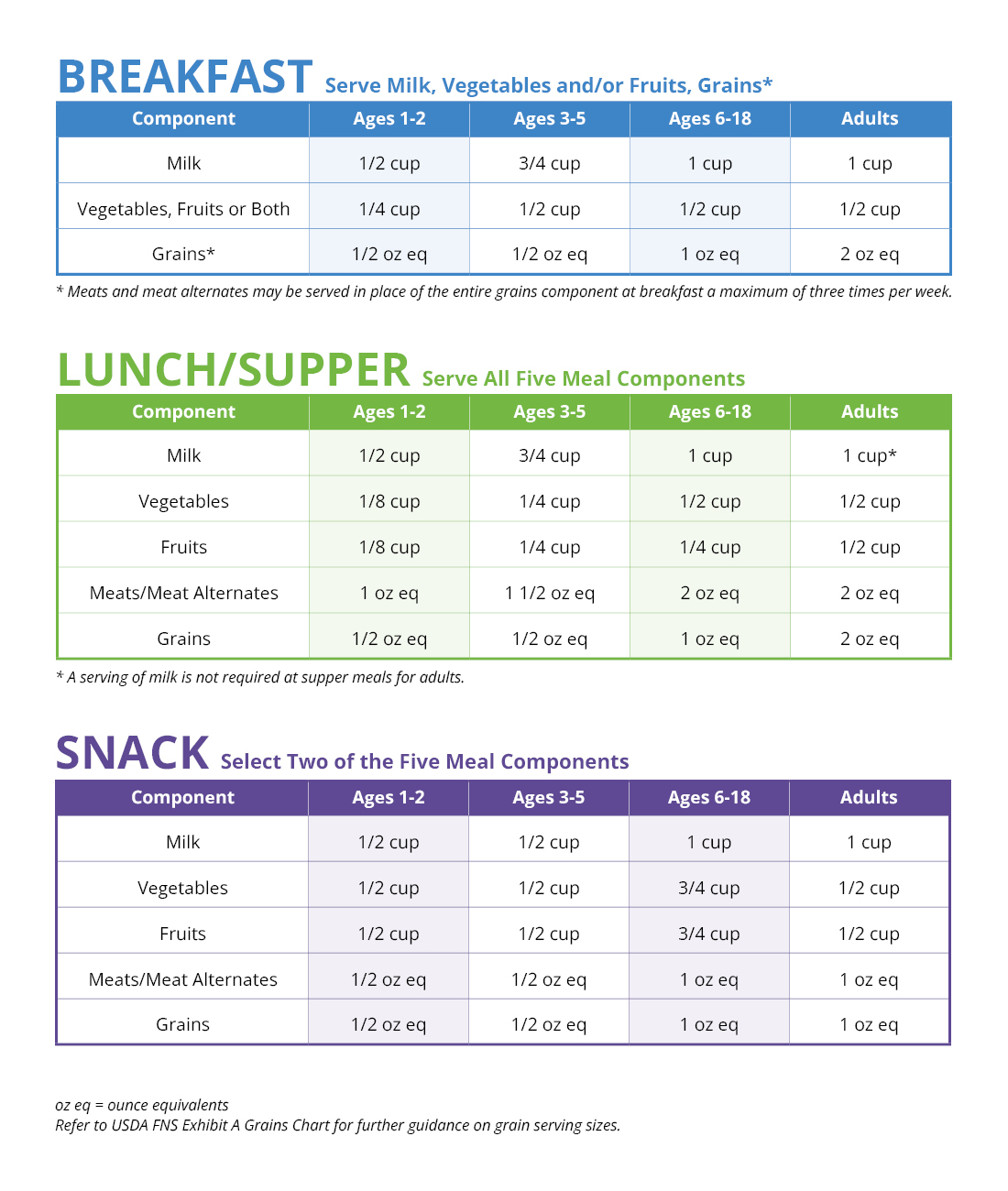
All meals and snacks must meet the CACFP meal pattern requirements. The CACFP meal patterns are designed to meet the needs of children and are based on the recommendations of the Dietary Guidelines for Americans (DGAs).
There are five meal components in the CACFP: grains, vegetables, fruits, meats/meat alternates and fluid milk.
A creditable breakfast requires three meal components: fluid milk, fruits and/or vegetables, and grains. The entire grains component may be substituted with meats/meat alternates no more than three times per week.
A creditable lunch or supper will include all five of the meal components. There is an exception to this rule, which is that a second, different vegetable may be served in place of the fruits component. Also, when serving adults, the fluid milk component at supper is optional.
Creditable snacks consist of two different meal components. Though not required, it is a best practice to make one of the meal components of a snack either a fruit or a vegetable.
The meal pattern states the required minimum serving size for each meal component. You can serve more food if needed, but the reimbursement rate remains the same.
The meal pattern is component-based and supports proper nutrition by age group. It includes the following 5 meal components:

What are the grain requirements?
- Must be made with enriched or whole grain meal or flour, or bran or germ.
- At least one serving of grains per day must be whole grain-rich when grains are served.
- Breakfast cereals must adhere to CACFP added sugar limits.
- Grains are measured in ounce equivalents (oz eq).
- Grain-based desserts are not creditable.
- A best practice is to provide at least two servings of whole grain-rich grains per day.
What are the vegetables requirements?
- Vegetables may be fresh, frozen, canned, dried (including beans, peas and lentils), or full strength (100%) vegetable juice.
- Full strength (100%) juice may count towards the entire fruits or vegetables component once per day.
- Beans, peas and lentils can credit toward the vegetables or meats/meat alternates component but not credit as both in the same meal or snack.
- A best practice is to provide at least one serving each of dark green vegetables; red and orange vegetables; beans, peas and lentils; starchy vegetables and other vegetables per week.

What are the fruits requirements?
- Fruits may be fresh, frozen, dried, canned (packed in water, fruit juice, or light syrup), and/or pasteurized, full-strength (100%) fruit juice.
- Full strength (100%) juice may count towards the entire fruits or vegetables component once per day.
- A best practice is to serve a variety of fruits and choose fresh, canned, frozen, or dried more often than juice.

What are the meats/meat alternates requirements?
- Commonly served meats include beef, chicken, fish, pork, turkey and surimi seafood.
- Commonly served meat alternates include beans, peas, lentils, cheese, whole eggs, nuts and seeds, nut and seed butters, tempeh, tofu and yogurt.
- Beans, peas and lentils can credit toward the vegetables or meats/meat alternates component but not credit as both in the same meal or snack.
- Yogurt must adhere to CACFP added sugar limits.
- Meats/meat alternates are measured in ounce equivalents (oz eq).
- Best practices include serving only lean meats, nuts, beans, peas and lentils; limiting processed meats to one serving per week; and serving only natural, low-fat or reduced-fat cheeses.

What are the fluid milk requirements?
- One-year-olds must be served unflavored whole milk.
- Two-to-five-year-olds may be served whole, reduced-fat (2%), low-fat (1%) or fat-free (skim) unflavored milk.
- Participants six years and older may be served whole, reduced-fat (2%), low-fat (1%) or fat-free (skim) unflavored milk, or low-fat (1%) or fat-free (skim) flavored milk.
- Infants (birth to 11 months) may be served expressed breastmilk or iron-fortified infant formula or may be breastfed onsite.
- Breastmilk is creditable at any age.
- A best practice is to serve only unflavored milk to all participants.
Download the meal pattern reference cards for free at cacfp.org/meal-patterns.
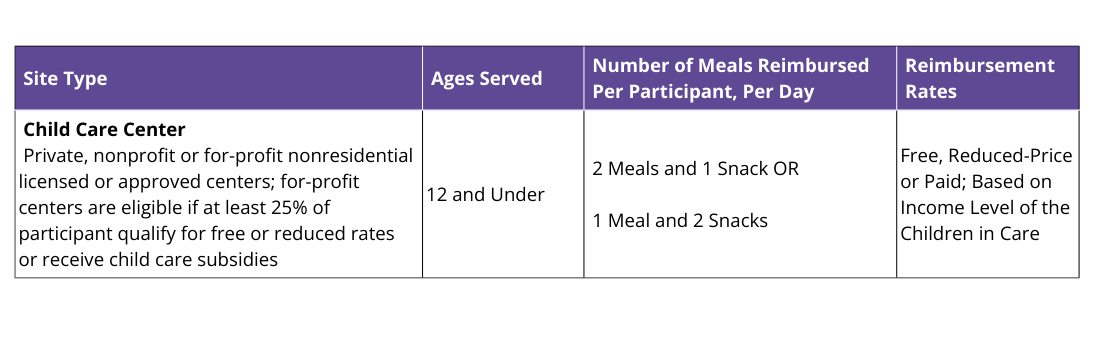
Child Care Centers can serve up to two meals and one snack, or one meal and two snacks, per participant per day.
Child care centers can determine their meal service model. Operators can:
- Prepare snacks and or meals onsite.
- Procure (purchase) meals (vended meals)
Child care center meals and/ or snacks must be served in a congregate setting. However, there are no federal requirements for how much time must pass between meal and snack services or how long each meal service should last. However, States may establish meal time requirements.
Child care centers have two options for meal service. They can implement either one or both of these types of meal services throughout each day: pre-plated and family style meal service.
What are the recordkeeping and reporting requirements?
The site must track attendance and record meal counts. Use daily forms or approved electronic systems to document the number of meals served and daily attendance.
Each month, claims must be submitted for reimbursement. If you are working with a sponsor, the sponsor will submit claims to the State agency on your behalf.
- Agreement / Application
- Current license or approval
- Menu
- Enrollment forms
- Income eligibility forms
- Daily Attendance
- Daily Meal Counts
Joining Made Easy
1. Find a Sponsor or Contact Your State Agency
A CACFP Sponsoring Organization (Sponsor) may help you claim reimbursement for the meals and snacks that you serve through the CACFP. They ensure that you are compliant with state and federal rules and assist you in proper reporting and other administrative functions. Visit info.cacfp.org/sponsor to find a Sponsor in your state.
You may also be eligible to become a Sponsor yourself. If you operate multiple child care centers, adult day care centers, at-risk afterschool programs or emergency shelters, you can contact your State agency to find out if you are eligible. If you are a family child care home, you must have a Sponsor in order to participate in the food program. If you are an independent center, you also have the option to enter into an agreement directly through your State agency. Visit cacfp.org/usda-state-agencies to find the contact in your state.
2. Determine Your Site Eligibility
Your Sponsor or State agency can help you figure out eligibility. The table below serves as a general guideline of what to expect based on the type of care facility you operate. Once your eligibility is determined, you can start receiving reimbursement based on the number of CACFP creditable meals and snacks served to those in your care. For the current reimbursement rates, visit cacfp.org/rates-of-reimbursement.
3. Receive CACFP Training
Your Sponsor or State agency will provide you with training. NCA also hosts multiple training webinars throughout the year, which you can find at info.cacfp.org/calendar or watch on demand at cacfp.org/learning-center.
4. Participate in the CACFP
Once you’re approved to operate the CACFP, now it’s time to start serving nutritious meals and snacks! Here are some questions to ask yourself:
- Where will you source your food?
- What will your menu planning look like?
- How many meals and snacks will you serve?
Look at who you are serving and your hours of operation to answer these questions.
Remember, you’re not in this alone! There are many valuable, free resources available at cacfp.org to help you ensure that the food you’re serving is reimbursable.
5. Become a CACFP Expert
Stay up-to-date on meal pattern guidance and food program policy. In addition to speaking with your Sponsor or State agency, here are four things that you can do:
Make a Difference: Advocacy for Child Care Centers
The National CACFP Association advocates for policies that strengthen the CACFP for child care centers.
What are the advocacy priorities?
- Simplifying, reducing and streamlining administrative requirements for sponsors and sites
- Streamline and improve the Serious Deficiency Process
- Streamline and simplify the meal pattern documentation paperwork
- Allow annual eligibility for for-profit child care centers
- Increase reimbursement rates to reflect rising food costs
- Increasing reimbursement by 10 cents for every meal and snack
- Provide reimbursement for an additional meal/snack for child care centers and family child care homes open for 8 hours or more
- Expand eligibility and access to the CACFP
- Extend area eligibility to child care centers
- Establish Community Eligibility Provision (CEP) for child care centers
How can you help?
- Contacting your elected officials
- Submitting comments during public rulemaking
- Sharing your success stories with advocacy partners
- Visit the Advocacy Page
- Visit the Action Center
Annoor Academy
Child Care Center
Annoor Academy of Knoxville is a private school working with children from pre-K through 8th grade. The preschool has expanded since its opening in 2000 and now serves breakfast, morning snacks, and lunches for 80 to 120 children a day through the CACFP. The preschool has made a commitment to nutrition, physical activity, and nutrition education.
"We want what is best for our students. They need to eat well and be healthy. We have to not only teach the children, but also teach the parents how to make good choices for a healthy lifestyle.”
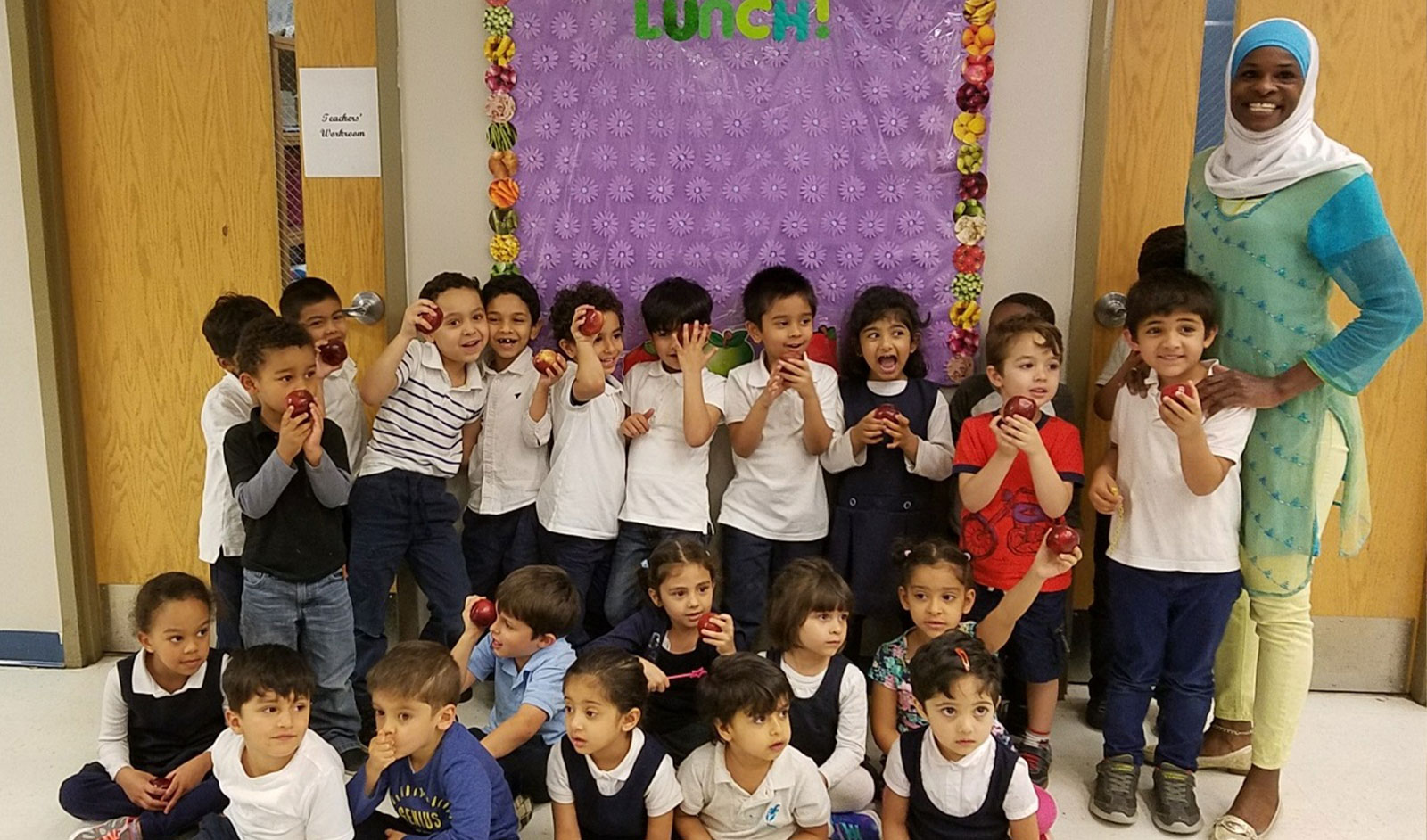
The school is trying to limit processed foods. Through generous donations and the Healthy Living Grant, they are making necessary kitchen changes to prepare healthy meals. A full-size salad bar was purchased and has allowed the school to showcase a variety of fresh fruits and vegetables, giving children the independence to choose for themselves. The next step is to install a commercial kitchen to eliminate the need for processed foods altogether.
The school started construction on a gymnasium and through the second part of the Healthy Living and Fitness Grant, they have been able to hire an outside company to teach the children physical education twice a week. Physical activity is key to children’s overall well-being. They hope to complete the gymnasium project and employ a full-time physical education instructor. Several after-school sports clubs have also been established to get students outside often and more physically active.
Considering the school’s influence is limited by hours in the school day, they have made the initiative to educate parents on the importance of healthy living. Monthly Family Night events are geared toward helping parents adopt healthy habits in the home to promote the whole child’s health education. Topics related to food, nutrition, adequate play and rest time, as well as literacy are covered.
In Knoxville, Tennessee, Annoor Academy has been a CACFP participant through Our Daily Bread of Tennessee since 2016.
Community Action Head Start
Head Start
In 1967, the Mid-Willamette Valley Community Action opened their doors as a direct result of President Johnson’s War on Poverty. As they saw a need in the community to work with the children, the Community Action Head Start began. The program has 13 sites and serves over 1000 children in Salem and the surrounding communities. Nutrition Director Natalie Bratton is proud and excited about the impact the program makes for the children.
"We are able to provide the families in our area with quality child care and at the same time provide the children with the food and nutrition they need in order to grow and develop.”
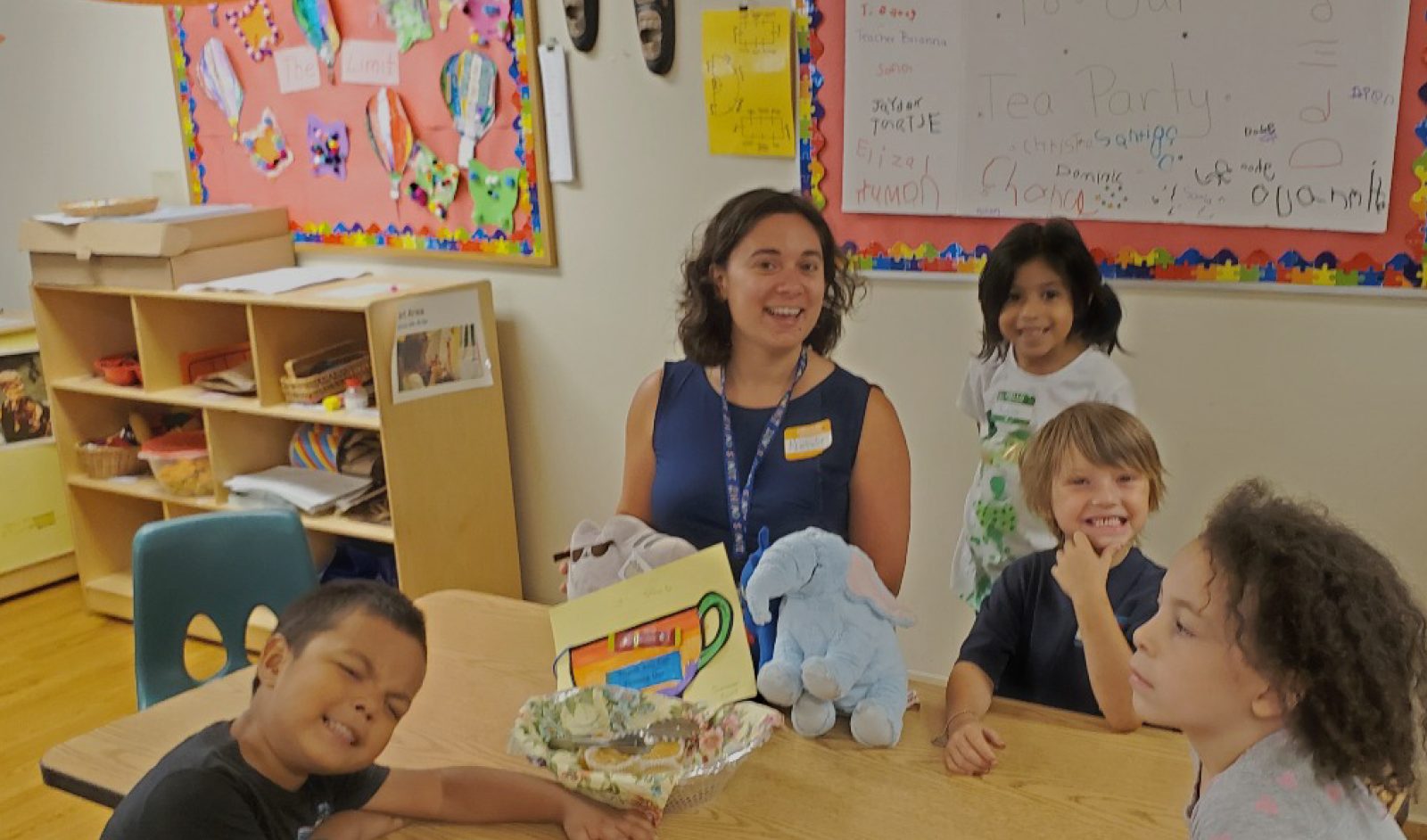
Nutrition and learning healthy habits will benefit the children for their lifetime. The Head Start uses the Harvest for Healthy Kids Curriculum where each month a different vegetable and fruit are focused on through all of the senses. At the largest site, they have created a community garden where parents and children work together. They have also started a physical activity program, Imagination Yoga, where children not only strengthen and calm their bodies, they learn how to focus the mind to be ready to learn.
Through the CACFP and Head Start, there are requirements to serve healthy food, but Natalie’s team goes beyond those. Last summer, they started an initiative to incorporate more culturally diverse foods into their cycle menus to appeal to their families. They asked for feedback from parents, teachers, and students. The children love the menus because they were involved in the process and given the title "Official Head Start Tasters." Recipes are always available for families to take home and try.
Parents benefit from nutrition education available through Family Educators and monthly parent meetings. Community Action Head Start wants the children in their care to succeed not just now, but throughout life, in all areas of life. Involving the parents and asking children to participate in their nutrition choices is part of attaining the overall goal. Natalie and her team know that by providing healthy food and healthy activities, they are giving them a chance to flourish in their own development.
In Salem, Oregon, Community Action Head Start Program has been a CACFP participant through Mid-Willamette Community Action Agency since 2008.