

1.2 million children served healthy afterschool meals
The final school bell has rung and kids have arrived at your afterschool program, which is buzzing with energy. Several kids are busy finishing their homework, others begin an arts and craft project and some are playing basketball. You know they are safe and engaged and also nourished, because you are also providing a healthy snack and/or supper.
For many children, that afterschool snack and/or supper is more than just a bite to eat. It may be the only nutritious meal they have between lunch and breakfast the next day. And for programs like yours, making sure every child is nourished can be a big responsibility, especially on a tight budget.
That’s where the USDA Child and Adult Care Food Program (CACFP) comes in.
The CACFP is federally funded, state-administered and designed to fight child hunger and improve nutrition. Participating in the CACFP strengthens afterschool programming and supports working families. Through the CACFP, afterschool programs across the country can receive reimbursement for snacks and suppers served to children in eligible areas. Not only can you serve meals after school, but the CACFP afterschool meal program also allows meals to be served on weekends and school breaks during the school year. This program helps you stretch your resources, support working families and give kids the nutrition they need to stay focused, safe and thriving after school.
Whether you run a school-based program, a nonprofit community center or a faith-based youth program, the CACFP at-risk afterschool program can help you make every afternoon count.
Why does the CACFP At-Risk Afterschool Meals Program Matter?
Over 13 million children face hunger, and one in every five children is unsure where they will get their next meal.
Currently, almost 27,000 sites serve afterschool meals or snacks and 1.2 million children receive afterschool supper, and yet only one in 16 children who received a free or reduced-price lunch was served by an afterschool food program. With millions of children not receiving meals it is critical to support the expansion of afterschool meal programs. As many children leave school each day unsure if they will have supper at home, or if their next meal won’t be until they return to school the following day, your organization can help fill the gap.
Where is there room for growth?
With millions of children eligible but not reached, expanding the CACFP afterschool meals program is both a need and an opportunity. Your organization can help fill the gap.
What does research show?
- Hunger is linked to difficulty focusing, lower test scores and chronic absenteeism.
- Children experiencing food insecurity are more likely to struggle with behavior, stress and social interaction.
- Programs offering meals show increased enrollment, stronger engagement and better outcomes.
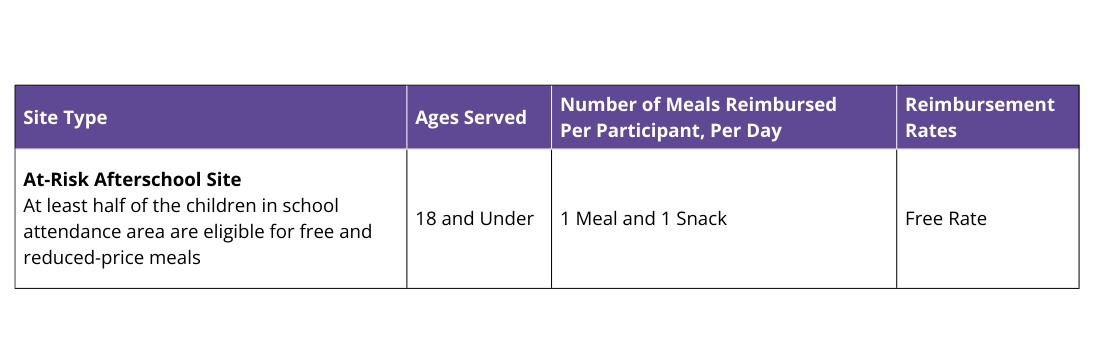
Many children rely on free or reduced-price meals served by school or child care centers during the day. But hunger does not end when school is out. During the school year, at-risk afterschool (ARAS) is the answer for operators wanting to provide nutritious meals after school, during school closures and on weekends. ARAS offers the opportunity to further impact the lives of our nation’s youth. In out-of-school time hours, children and teenagers need supervision, support and nutrition to continue learning and growing. Through the CACFP, organizations in eligible areas can serve free meals and snacks to youth 18 and under (or who turn 19 during the school year) while also offering safe, enriching environments.
What are the benefits of serving meals through ARAS?
- Combat Food Insecurity: the program ensures they receive nutritious meals and/or snacks which can be a lifeline for families struggling to provide consistent meals.
- Support Healthy Development: meals served meet CACFP meal pattern standards and lead to better lifelong healthy habits.
- Improve Program Appeal: offering meals can increase participation in afterschool programs and parents are more likely to enroll their children if meals are provided.
- Strengthen Program Support: reimbursement supports providing more nutritious foods and helps offset the costs of providing comprehensive services.
- Support Working Families: Working parents and caregivers rely on afterschool programs for both care and meals.
- Increase Community Impact: Along with school meals, participating in ARAS strengthens overall services to the surrounding community.
ARAS Program Overview
Who can participate?
Organization may participate in the CACFP as an at-risk afterschool site, either as an independent afterschool program or through a sponsor. Independent programs contract directly with the State agency. Working with a sponsor minimizes the paperwork burden and increases technical assistance.
What are the site eligibility requirements?
Afterschool programs that meet the requirements below are eligible to receive reimbursement for meals and snacks.
To participate in the CACFP as an at-risk afterschool site, a program must:
- Be organized to provide care for children (18 years and under) after school or on weekends, holidays or school closures during the regular school year. (Note: Operators wanting to continue food service during the summer can elect to participate in the USDA Summer Food Service Program).
- Provide education or enrichment activities in a structured and supervised environment that is open to all children. There is no requirement that all children receiving meals participate in the scheduled activities; they just need to be made available.
- Be located in an attendance area of a school where at least 50 percent or more of the children are eligible for free or reduced-price meals.
What organizations are eligible?
Afterschool sites must be operated by an eligible organization to receive reimbursement. These organizations must meet State and/or local licensing or health and safety standards and must be operated by public agencies (such as schools or city governments), tax-exempt nonprofit organizations, eligible for-profit centers and organizations operating other federal programs that require nonprofit status.
Examples of Eligible Organizations:
- Public, private and charter schools
- School districts
- Libraries with youth programming
- Faith-based organizations with structured youth engagement
- Parks and recreation departments
- Boys & Girls Clubs and youth centers
- Shelters, group homes, and transitional housing with programming
- Nonprofit organizations focused on child development or education
- Eligible for-profit centers
- Child care centers
- State or local government agencies
Is there required training?
Annual training is required for staff operating the CACFP. Training includes meal pattern information, record-keeping requirements and civil rights compliance.
ARAS Meal Service
All meals and snacks must meet the CACFP meal pattern requirements. The CACFP meal patterns are designed to meet the needs of children and are based on the recommendations of the Dietary Guidelines for Americans (DGAs).
There are five meal components in the CACFP: grains, vegetables, fruits, meats/meat alternates and fluid milk.
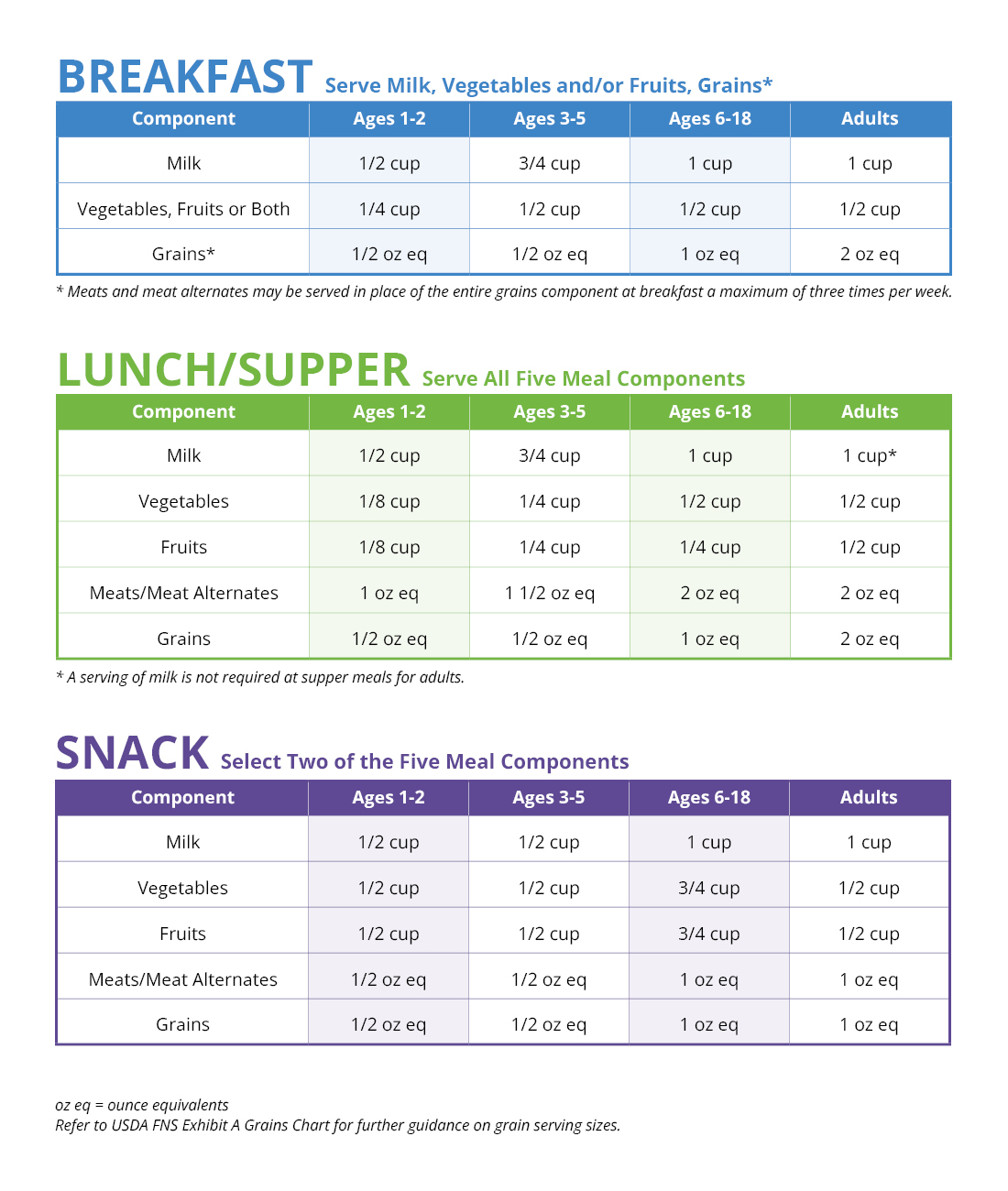
A creditable breakfast requires three meal components: fluid milk, fruits and/or vegetables, and grains. The entire grains component may be substituted with meats/meat alternates no more than three times per week.
A creditable lunch or supper will include all five of the meal components. There is an exception to this rule, which is that a second, different vegetable may be served in place of the fruits component. Also, when serving adults, the fluid milk component at supper is optional.
Creditable snacks consist of two different meal components. Though not required, it is a best practice to make one of the meal components of a snack either a fruit or a vegetable.
The meal pattern states the required minimum serving size for each meal component. You can serve more food if needed, but the reimbursement rate remains the same.
The meal pattern is component-based and supports proper nutrition by age group. It includes the following 5 meal components:

What are the grains requirements?
- Must be made with enriched or whole grain meal or flour, or bran or germ.
- At least one serving of grains per day must be whole grain-rich when grains are served.
- Breakfast cereals must adhere to CACFP sugar limits.
- Grains are measured in ounce equivalents (oz eq).
- Grain-based desserts are not creditable.
- A best practice is to provide at least two servings of whole grain-rich grains per day.
What are the vegetables requirements?
- Vegetables may be fresh, frozen, canned, dried (including beans, peas and lentils), or full strength (100%) vegetable juice.
- Full strength (100%) juice may count towards the entire fruits or vegetables component once per day.
- Beans, peas and lentils can credit toward the vegetables or meats/meat alternates component but not credit as both in the same meal or snack.
- A best practice is to provide at least one serving each of dark green vegetables; red and orange vegetables; beans, peas and lentils; starchy vegetables and other vegetables per week.

What are the fruits requirements?
- Fruits may be fresh, frozen, dried, canned (packed in water, fruit juice, or light syrup), and/or pasteurized, full-strength (100%) fruit juice.
- Full strength (100%) juice may count towards the entire fruits or vegetables component once per day.
- A best practice is to serve a variety of fruits and choose fresh, canned, frozen, or dried more often than juice.

What are the meats/meat alternates requirements?
- Commonly served meats include beef, chicken, fish, pork, turkey and surimi seafood.
- Commonly served meat alternates include beans, peas, lentils, cheese, whole eggs, nuts and seeds, nut and seed butters, tempeh, tofu and yogurt.
- Beans, peas and lentils can credit toward the vegetables or meats/meat alternates component but not credit as both in the same meal or snack.
- Yogurt must adhere to CACFP sugar limits.
- Meats/meat alternates are measured in ounce equivalents (oz eq).
- Best practices include serving only lean meats, nuts, beans, peas and lentils; limiting processed meats to one serving per week; and serving only natural, low-fat or reduced-fat cheeses.

What are the fluid milk requirements?
- One-year-olds must be served unflavored whole milk.
- Two-to-five-year-olds may be served whole, reduced-fat (2%), low-fat (1%) or fat-free (skim) unflavored milk.
- Participants six years and older may be served whole, reduced-fat (2%), low-fat (1%) or fat-free (skim) unflavored milk, or low-fat (1%) or fat-free (skim) flavored milk.
- Infants (birth to 11 months) may be served expressed breastmilk or iron-fortified infant formula, or may be breastfed onsite.
- Breastmilk is creditable at any age.
- A best practice is to serve only unflavored milk to all participants.
Download the meal pattern reference cards for free at cacfp.org/meal-patterns.
ARAS sites can serve one snack and one supper after school. During the school year on weekends and during school closures, ARAS may serve one meal (breakfast, lunch or supper) and one snack. Note: Different rules apply for summer program. See our SUN Meals page for summer options.
ARAS operators can determine their meal service model. Operators can:
- Prepare snacks and/or meals on-site.
- Procure (purchase) meals (vended meals)
ARAS meals and/or snacks must be served in a congregate setting. However, there are no federal requirements for how much time must pass between the end of school and the meal service. Additionally, there is no federal requirement for the order of the meal and snack service. However, States may establish meal time requirements.
ARAS does provide for some meal service flexibilities.
- Sites can implement Offer vs Serve meal service for breakfast, lunch or supper.
- Sites can also implement pre-plated and family style meal service.
- Participants can take one meal component off site. It must be either a vegetable, fruit or grain.
- Operators can implement the use of “share tables,” which are tables or stations where children may return whole food or beverage items they choose not to eat, if it is in compliance with local and State health and food safety codes. Connect with your Sponsor or State agency for more information.
What are the recordkeeping and reporting requirements?
The site must track attendance and record meal counts. Use daily forms or approved electronic systems to document the number of meals served and daily attendance.
Each month, claims must be submitted for reimbursement. If you are working with a sponsor, the sponsor will submit claims to the State agency on your behalf.
- Agreement / Application
- Comply with State or local health & safety standards (check to see if State or local licensing or approval is required)
- Menu
- Daily Attendance
- Daily Meal Counts
- Enrichment Activity
Joining Made Easy
1. Find a Sponsor or Contact Your State Agency
A CACFP Sponsoring Organization (Sponsor) may help you claim reimbursement for the meals and snacks that you serve through the CACFP. They ensure that you are compliant with state and federal rules and assist you in proper reporting and other administrative functions. Visit info.cacfp.org/sponsor to find a Sponsor in your state.
You may also be eligible to become a Sponsor yourself. If you operate multiple child care centers, adult day care centers, at-risk afterschool programs or emergency shelters, you can contact your State agency to find out if you are eligible. If you are a family child care home, you must have a Sponsor in order to participate in the food program. If you are an independent center, you also have the option to enter into an agreement directly through your State agency. Visit cacfp.org/usda-state-agencies to find the contact in your state.
2. Determine Your Site Eligibility
Your Sponsor or State agency can help you figure out eligibility. The table below serves as a general guideline of what to expect based on the type of care facility you operate. Once your eligibility is determined, you can start receiving reimbursement based on the number of CACFP creditable meals and snacks served to those in your care. For the current reimbursement rates, visit cacfp.org/rates-of-reimbursement.
3. Receive CACFP Training
Your Sponsor or State agency will provide you with training. NCA also hosts multiple training webinars throughout the year, which you can find at info.cacfp.org/calendar or watch on demand at cacfp.org/learning-center.
4. Participate in the CACFP
Once you’re approved to operate the CACFP, now it’s time to start serving nutritious meals and snacks! Here are some questions to ask yourself:
- Where will you source your food?
- What will your menu planning look like?
- How many meals and snacks will you serve?
Look at who you are serving and your hours of operation to answer these questions.
Remember, you’re not in this alone! There are many valuable, free resources available at cacfp.org to help you ensure that the food you’re serving is reimbursable.
5. Become a CACFP Expert
Stay up-to-date on meal pattern guidance and food program policy. In addition to speaking with your Sponsor or State agency, here are four things that you can do:
Make a Difference: Advocacy for At-Risk Afterschool Programs
The National CACFP Association advocates for policies that strengthen the CACFP for at-risk afterschool sites.
What are the advocacy priorities?
- Simplifying, reducing and streamlining administrative requirements for sponsors and sites
- Streamline and improve the Serious Deficiency Process
- Streamline and simplify the meal pattern documentation paperwork
- Increasing reimbursement rates to reflect rising food costs
- Increasing reimbursement by 10 cents for every meal and snack
- Expanding eligibility and flexibility for rural and underserved communities
- Reducing the area eligibility percentage to 40%
- Increase the multiplier for determining area eligibility percentage from the Community Eligibility Provision
- Allow the predominant school percentage to meet the qualification for At-Risk Afterschool programs
- Supporting year-round nutrition access by allowing afterschool meal programs to operate year-round
How can you help?
- Contacting your elected officials
- Submitting comments during public rulemaking
- Sharing your success stories with advocacy partners
- Visit the Advocacy Page
- Visit the Action Center
Central Arkansas Library System
At-Risk Afterschool Site
The Central Arkansas Library System (CALS) operates CACFP ARAS and the Summer Food Service Program (SFSP) through its “Be Mighty” program. The Be Mighty program runs in 11 branches throughout the Little Rock, Arkansas area and serves over 63,000 meals and snacks each year.
Although libraries may not be set up to cook meals on site and may not be the first place that comes to mind when thinking of accessing meals, Be Mighty has found a model that is successful. Be Mighty’s CACFP sponsoring organization, Bridge 2 Success, also acts as their vendor and prepares and delivers creditable suppers and snacks to all of the libraries each school day. Jessica raves about the menus created by Bridge 2 Success. The meals are hot and fresh and include delicious items like chili mac, chicken and dumplings and walking tacos.
One of the primary goals of libraries is to promote education and literacy. But it’s well known that children can’t learn on an empty stomach and their educational outcomes improve when they have consistent access to nutritious meals.
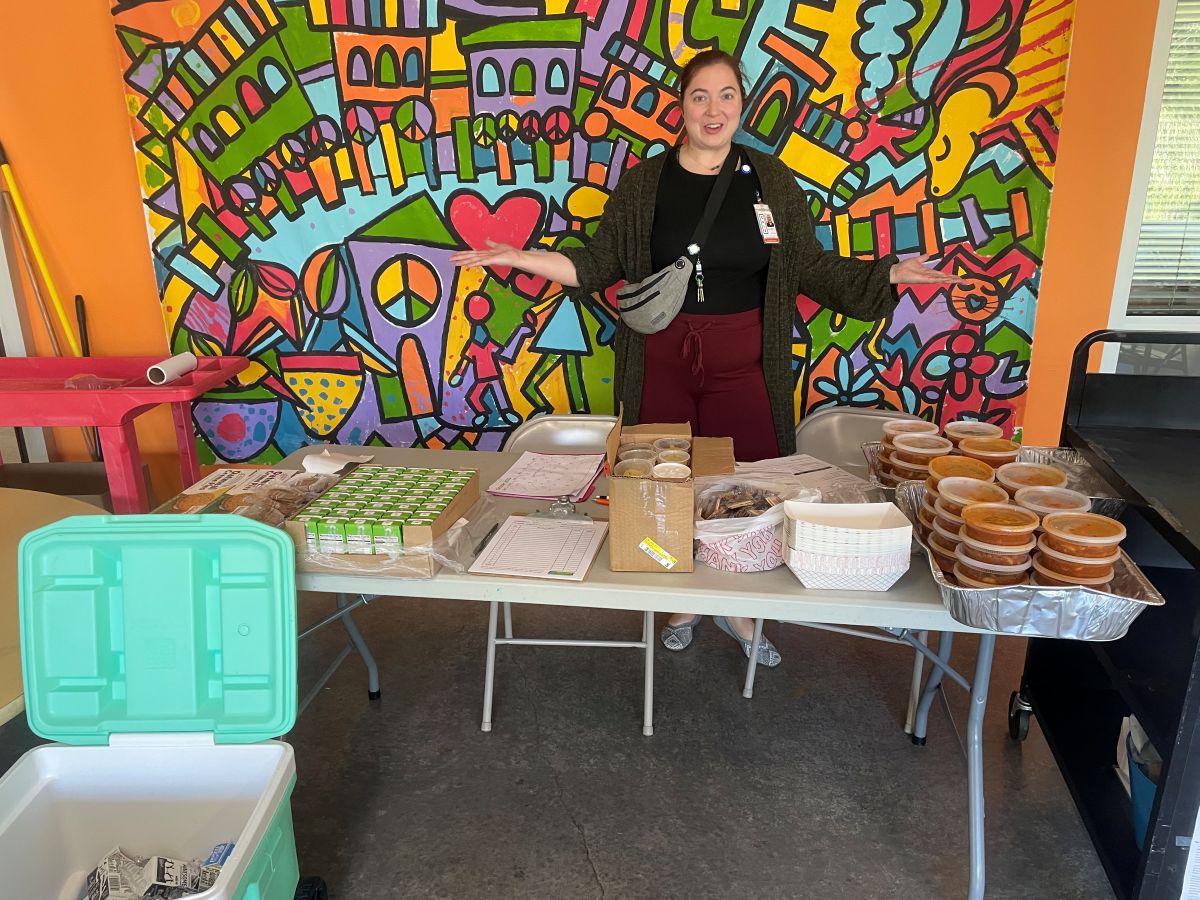
Libraries can play a significant role in their communities by providing educational resources and programming, but also by helping to address food access and food insecurity.
Indiana Alliance of Boys & Girls Clubs
At-Risk Afterschool Site
Indiana Alliance of Boys & Girls Clubs (BGCIN) is also a sponsor of 42 clubs participating in CACFP At-Risk Afterschool and 16 clubs participating in SFSP. During the school year, BGCIN ensures meals to around 8,500 children, and during the summer they support meal service to approximately 3,000 children.
BGCIN also gets their kids involved with the meals. Most of their clubs do taste test activities with the kids in August when the afterschool programs are starting back up, so that the kids can provide their feedback on the types of foods they like and don’t like. BGCIN uses their feedback to adapt their menus for the rest of the year. Lana thinks this feedback is invaluable, because they’ve learned that the kids love foods that BGCIN wouldn’t have thought kids would eat (boiled eggs) and didn’t like foods they thought the kids would enjoy. Plus, taste tests are a lot of fun for kids and staff!
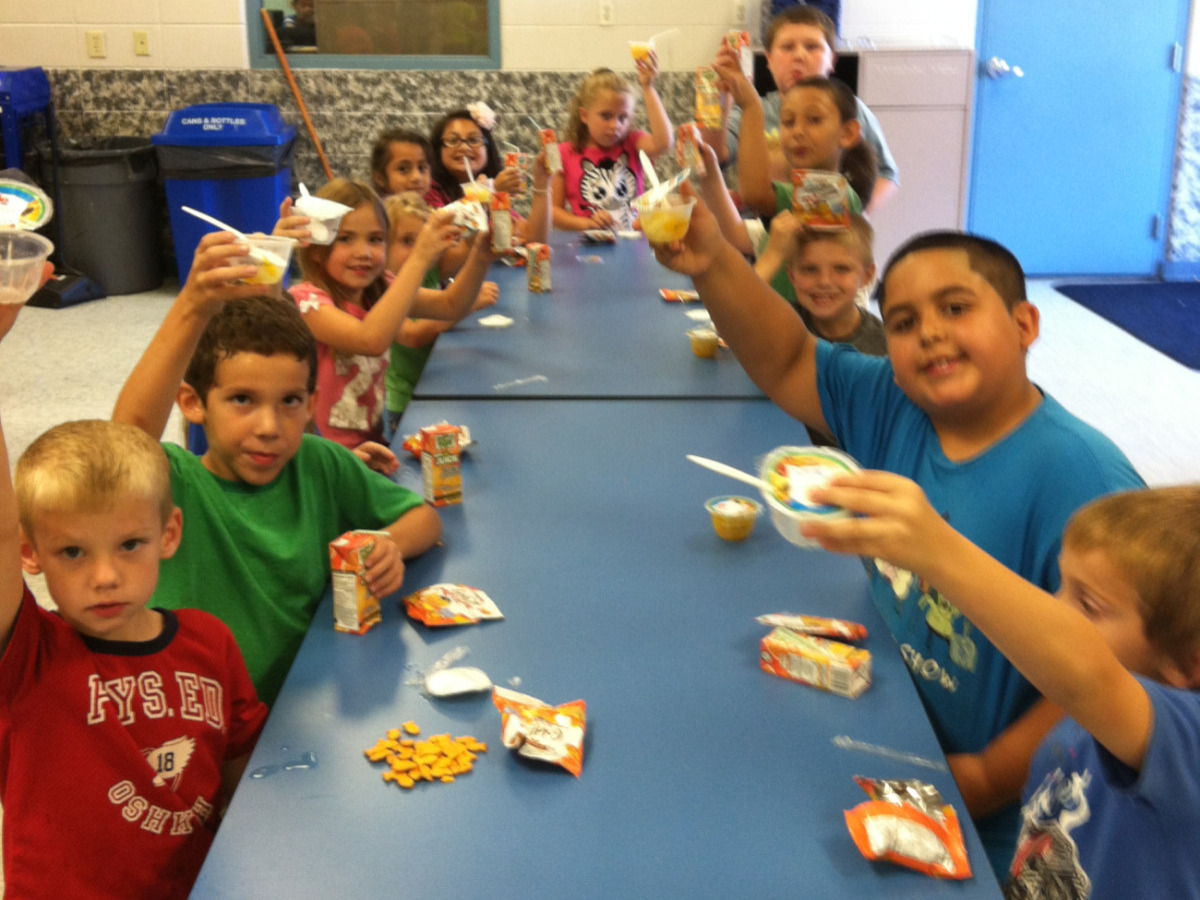
The CACFP helps their clubs offer opportunities to serve better and more nutritious options to the kids. The children are getting access to healthier foods than what they would get outside of the program. They’ve even received letters from parents thanking them for providing food for their kids, because busy work schedules prevent them from being home to give their children dinner.