

135,000 adults served healthy meals & snacks daily
Mealtime is more than nourishment; it’s a moment of connection, comfort and care. Each day, our dining space welcomes adults to enjoy both nutrition and friendship. Meals are served with dignity and warmth, fostering a sense of community and belonging.
For many adults who attend your program, these meals are more than just food. They provide nourishment for the body and spirit. And for adult day care centers like yours, providing balanced, high-quality meals every day can be both meaningful and challenging.
That’s where the Child and Adult Care Food Program (CACFP) comes in.
The CACFP is a federally funded, State-administered program designed to improve nutrition and support community-based care. Participating in the CACFP strengthens adult day care centers by helping cover the cost of serving nutritious meals and snacks to older adults and adults with disabilities. Through the CACFP, centers across the country can receive reimbursement for eligible meals served to participants in care.
Not only can you serve meals during regular program hours, but the CACFP adult care meal program also supports weekend and extended-hour services to meet the needs of your participants. This program helps you stretch your resources, support caregivers and provide the nourishment adults need to stay healthy, independent and thriving.
Why does the CACFP Adult Care Program Matter?
More than 5 million older adults in the U.S. experience food insecurity, and many adults with disabilities face additional barriers to accessing nutritious meals. Across the country, thousands of adult day care centers participate in the CACFP to help fill this gap—but many more could benefit from the food program’s support. For adults who depend on community-based care during the day, CACFP-funded meals provide essential nourishment, dignity and connection.
As the population of older adults continues to grow, ensuring consistent access to nutritious meals becomes even more critical. Your organization can help reduce hunger, support wellness and create meaningful impact through the CACFP.
Where is there room for growth?
Many eligible adult day care centers are not yet benefiting from the CACFP. Expanding participation is both a need and an opportunity. Your center can help meet that need and make a lasting difference in your community.
What does research show?
- Food insecurity among older adults is linked to increased risk of chronic disease, malnutrition and reduced quality of life.
- Access to nutritious meals supports better health outcomes, independence, and emotional well-being.
- Programs that provide meals see stronger engagement, improved attendance, and greater satisfaction among participants and caregivers.
Many older adults rely on limited incomes, family support or community programs to meet daily nutritional needs. But hunger and poor nutrition don’t stop when the day ends. The CACFP helps ensure participants receive balanced meals and snacks throughout their day, reducing food insecurity and promoting healthier, more fulfilling lives.
Through the CACFP, adult day care centers can provide free, nutritious meals that meet USDA standards while also creating safe, supportive and socially engaging environments for participants.
What are the benefits of serving meals through the CACFP?
- Combat Food Insecurity: The program ensures that older adults and adults with disabilities receive consistent, nutritious meals that help reduce hunger and malnutrition.
- Support Health and Independence: CACFP meals meet CACFP standards and contribute to better physical health, energy and daily functioning.
- Enhance Program Quality: Offering meals can improve satisfaction and participation, helping your center attract and retain more participants.
- Strengthen Financial Stability: Meal reimbursements help offset food costs, allowing centers to reinvest savings into care and enrichment activities.
- Support Caregivers: Reliable nutrition during the day eases the burden on family members and caregivers, providing peace of mind.
- Increase Community Impact: By participating in the CACFP, your center strengthens community-based care and promotes wellness for those who need it most.
Adult Day Care Program Overview
Who can participate?
Adult day care centers that provide structured, comprehensive services to:
- Elderly adults that are 60 years or older
- Chronically impaired disabled adults, 18 years of age or older
To participate in the CACFP as an adult day care center, a program must:
What are the site eligibility requirements?
Adult Care programs that meet the requirements below are eligible to receive reimbursement for meals and snacks.
- Provide non-residential day care services
- Offer a structured program including health, social, and related support services
- Be licensed or approved by state or local authorities to provide adult day care services
- Serve meals/snacks to adult participants in their care
What organizations are eligible?
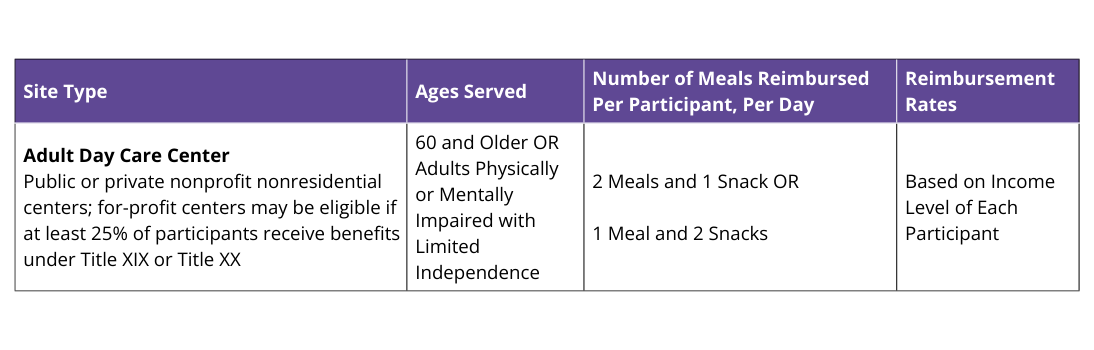
- Operated by a public or private nonprofit organization or for-profit organization where 25% of enrolled participants receive compensation from Title XIX (Medicaid) and/or Title XX (Social Services Block Grant).
- Capable of managing CACFP requirements, including meal service, recordkeeping and financial accountability.
Examples of Eligible Organizations:
- Local governments
- Health departments
- Senior service agencies
- Faith-based or community organizations
Is training required?
Annual training is required for staff operating the CACFP. Training includes meal pattern information, record-keeping requirements and civil rights compliance.
Adult Day Care Meal Service
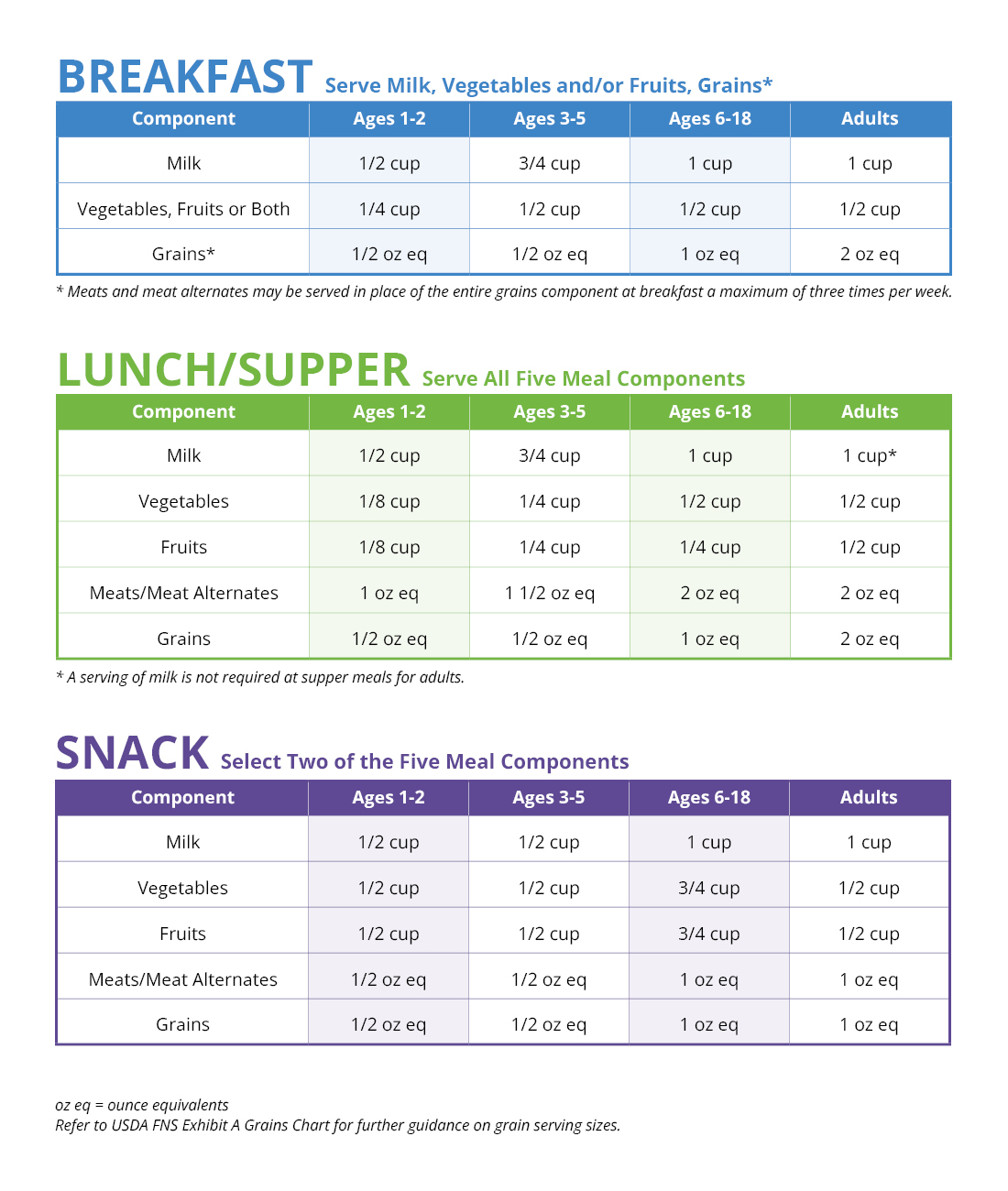
All meals and snacks must meet the CACFP meal pattern requirements. The CACFP meal patterns are designed to meet the needs of adults and are based on the recommendations of the Dietary Guidelines for Americans (DGAs).
There are five meal components in the CACFP: grains, vegetables, fruits, meats/meat alternates and fluid milk.
A creditable breakfast requires three meal components: fluid milk, fruits and/or vegetables, and grains. The entire grains component may be substituted with meats/meat alternates no more than three times per week.
A creditable lunch or supper will include all five of the meal components. There is an exception to this rule, which is that a second, different vegetable may be served in place of the fruits component. Also, when serving adults, the fluid milk component at supper is optional.
Creditable snacks consist of two different meal components. Though not required, it is a best practice to make one of the meal components of a snack either a fruit or a vegetable.
The meal pattern states the required minimum serving size for each meal component. You can serve more food if needed, but the reimbursement rate remains the same.
The meal pattern is component-based and supports proper nutrition by age group. It includes the following 5 meal components:

What are the grains requirements?
- Must be made with enriched or whole grain meal or flour, or bran or germ.
- At least one serving of grains per day must be whole grain-rich when grains are served.
- Breakfast cereals must adhere to CACFP sugar limits.
- Grains are measured in ounce equivalents (oz eq).
- Grain-based desserts are not creditable.
- A best practice is to provide at least two servings of whole grain-rich grains per day.

What are the vegetables requirement?
- Vegetables may be fresh, frozen, canned, dried (including beans, peas and lentils), or full strength (100%) vegetable juice.
- Full strength (100%) juice may count towards the entire fruits or vegetables component once per day.
- Beans, peas and lentils can credit toward the vegetables or meats/meat alternates component but not credit as both in the same meal or snack.
- A best practice is to provide at least one serving each of dark green vegetables; red and orange vegetables; beans, peas and lentils; starchy vegetables and other vegetables per week.

What are the fruits requirements?
- Fruits may be fresh, frozen, dried, canned (packed in water, fruit juice, or light syrup), and/or pasteurized, full-strength (100%) fruit juice.
- Full strength (100%) juice may count towards the entire fruits or vegetables component once per day.
- A best practice is to serve a variety of fruits and choose fresh, canned, frozen, or dried more often than juice.

What are the meats/meat alternates requirements?
- Commonly served meats include beef, chicken, fish, pork, turkey and surimi seafood.
- Commonly served meat alternates include beans, peas, lentils, cheese, whole eggs, nuts and seeds, nut and seed butters, tempeh, tofu and yogurt.
- Beans, peas and lentils can credit toward the meats/meat alternates or vegetables component but not credit as both in the same meal or snack.
- Yogurt must adhere to CACFP sugar limits.
- Meats/meat alternates are measured in ounce equivalents (oz eq).
- Best practices include serving only lean meats, nuts, beans, peas and lentils; limiting processed meats to one serving per week; and serving only natural, low-fat or reduced-fat cheeses.

What are the fluid milk requirements?
- Adults may be served low-fat (1%) or fat-free (skim) unflavored milk, or low-fat (1%) or fat-free (skim) flavored milk.
- For adults, yogurt may be served in place of fluid milk once per day.
- For adults, at supper, fluid milk is optional. Water is a great choice if milk is not served.
- A best practice is to serve only unflavored milk to all participants.
Download the meal pattern reference cards for free at cacfp.org/meal-patterns.
Adult day care centers can serve up to two meals and one snack, or one meal and two snacks, per participant per day.
Adult day care center operators can determine their meal service model. Operators can:
- Prepare snacks and or meals onsite.
- Procure (purchase) meals (vended meals)
Adult day care center meals and/ or snacks must be served in a congregate setting. However, there are no federal requirements for how much time must pass between meal and snack services or how long each meal service is. However, States may establish meal time requirements.
Adult day care centers do provide for some meal service flexibilities.
- Sites can implement Offer vs Serve meal service for breakfast, lunch or supper.
- Sites can also implement pre-plated and family style meal service.
What are the recordkeeping and reporting requirements?
The site must track attendance and record meal counts. Use daily forms or approved electronic systems to document the number of meals served and daily attendance.
Each month, claims must be submitted for reimbursement. If you are working with a sponsor, the sponsor will submit claims to the State agency on your behalf.
- Agreement and application
- Current license or approval
- Menu
- Enrollment forms
- Income eligibility forms
- Daily attendance
- Daily meal counts
Joining Made Easy
1. Find a Sponsor or Contact Your State Agency
A CACFP Sponsoring Organization (Sponsor) may help you claim reimbursement for the meals and snacks that you serve through the CACFP. They ensure that you are compliant with state and federal rules and assist you in proper reporting and other administrative functions. Visit info.cacfp.org/sponsor to find a Sponsor in your state.
You may also be eligible to become a Sponsor yourself. If you operate multiple child care centers, adult day care centers, at-risk afterschool programs or emergency shelters, you can contact your State agency to find out if you are eligible. If you are a family child care home, you must have a Sponsor in order to participate in the food program. If you are an independent center, you also have the option to enter into an agreement directly through your State agency. Visit cacfp.org/usda-state-agencies to find the contact in your state.
2. Determine Your Site Eligibility
Your Sponsor or State agency can help you figure out eligibility. The table below serves as a general guideline of what to expect based on the type of care facility you operate. Once your eligibility is determined, you can start receiving reimbursement based on the number of CACFP creditable meals and snacks served to those in your care. For the current reimbursement rates, visit cacfp.org/rates-of-reimbursement.
3. Receive CACFP Training
Your Sponsor or State agency will provide you with training. NCA also hosts multiple training webinars throughout the year, which you can find at info.cacfp.org/calendar or watch on demand at cacfp.org/learning-center.
4. Participate in the CACFP
Once you’re approved to operate the CACFP, now it’s time to start serving nutritious meals and snacks! Here are some questions to ask yourself:
- Where will you source your food?
- What will your menu planning look like?
- How many meals and snacks will you serve?
Look at who you are serving and your hours of operation to answer these questions.
Remember, you’re not in this alone! There are many valuable, free resources available at cacfp.org to help you ensure that the food you’re serving is reimbursable.
5. Become a CACFP Expert
Stay up-to-date on meal pattern guidance and food program policy. In addition to speaking with your Sponsor or State agency, here are four things that you can do:
Make a Difference: Advocacy for Adult Care Programs
The National CACFP Association advocates for policies that strengthen the CACFP for adult day care centers.
What are the advocacy priorities?
- Simplifying, reducing and streamlining administrative requirements for sponsors and sites
- Streamline and improve the Serious Deficiency Process
- Streamline and simplify the meal pattern documentation paperwork
- Increase reimbursement rates to reflect rising food costs
- Increasing reimbursement by 10 cents for every meal and snack
How can you help?
- Contacting your elected officials
- Submitting comments during public rulemaking
- Sharing your success stories with advocacy partners
- Visit the Advocacy Page
- Visit the Action Center
Arnaldo Ferrer
Adult Care Provider
Arnaldo Ferrer has been an adult care giver since 2013. In 2017, he brought his vision to life and opened Cielo Vista Senior Day Care where his family works with him to provide care for the clients. Cielo Vista specializes in the care of the disabled and elderly population of Las Vegas, Nevada, where clients come in the morning and spend the day. The center provides transportation to and from its clients’ homes each day and medical appointments when needed. They have an on-site nurse to help with any medical needs. Arnaldo’s center focuses on mental health with two major components: nutrition and activity.
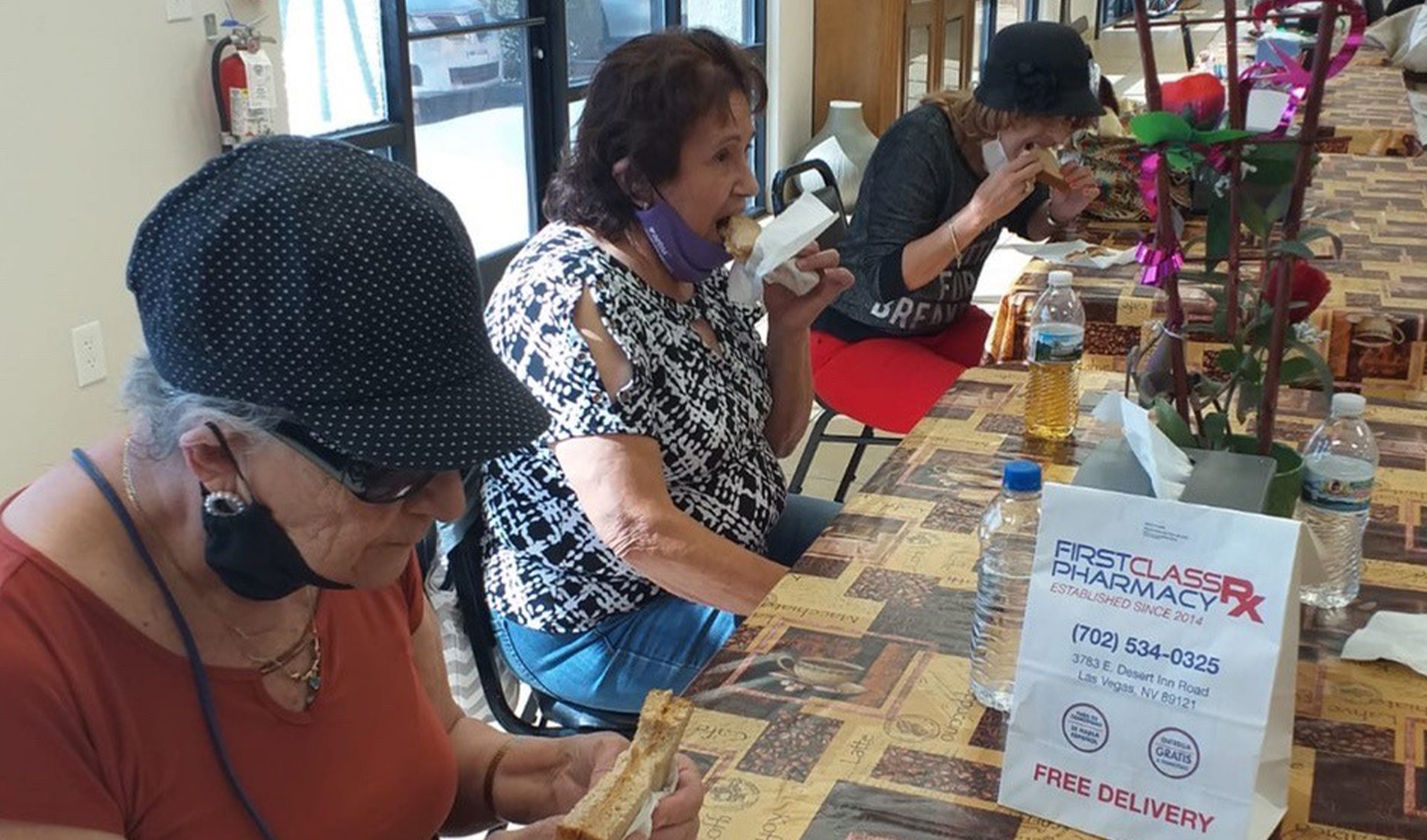
Each day, the clients come to the center and are served a healthy breakfast, snacks and lunch. The population of the center is 98% Hispanic, for which Arnaldo says health and nutrition play an even more critical role with cultural eating habits. Several suffer from high blood pressure, diabetes, and/or are at risk for heart problems. Once a month, a nutritionist reviews all of the menus and visits with the clients at the center about nutrition information. The on-site nurse teaches classes about good nutritional habits and healthy eating, focusing on advanced age. The nurse is also very involved with the clients regarding weight and nutritional eating for diabetes. The goal is to teach the clients how to make better choices when eating.
The other piece of the puzzle for improving health is social interaction and activity. Arnaldo has daily activities for the seniors. They can take part in crafts and singing with live music. They can also join in on a game of dominoes, exercise classes, or even learn English with an ESL teacher. They try to go on a park field trip three times a year, depending on mobility allowances of the clients.
“The staff is amazing and we care deeply for our seniors. It is a lot of hard work, but we do the work from our hearts and it is truly gratifying.”
The CACFP has played a critical role for Arnaldo and Cielo Vista because nutrition is such a focal point for the center. Arnaldo wants to provide the healthiest and best food he possibly can. The financial help from the CACFP allows Arnaldo to provide his clients with high quality, nutritious food. With the COVID-19 pandemic, the center was certainly affected, and CACFP has positively helped to offset the costs while many people are now choosing to stay home. Arnaldo always wants to be able to provide the nutritional foods his clients need.
“When I am that age, I would love to go to a place just like this. It will be the best six hours of the day.”
In Las Vegas, Nevada, Cielo Vista Senior Day Care Center has been a CACFP participant through Food For Kids, Inc. since 2019.
Diamond Center
Adult Day Care
The Diamond Center Adult Day Program is a Community Access Group offering person-centered services to individuals with intellectual and developmental disabilities working to improve, acquire or retain communication and socialization skills. These skills are implemented for active participation and independent functioning outside of their home setting. Sheila Russell, director, had a vision to open a center that would make a positive impact through enhancement and advancement of the individuals regardless of their disability. That vision became a reality when the Diamond Center opened in July of 2013.
“I believe that everyone can learn something no matter how long it may take or how simple the task may be. Engagement and positive reinforcement, as well as support in giving assistance for the goal at hand, is extremely significant. We will continue to encourage a healthy lifestyle through diet, exercise and rest with the hope of a most enjoyable life. Community relationship is vital, giving our individuals a sense of belonging and self-worth as they volunteer and work. It is rewarding to see them celebrating their victories and joy in knowing they can accomplish much with support from those who have essential interest in their success in life.”
Healthy lifestyle is a focal point for the Diamond Center. The center encourages individuals to acquire healthy dietary habits, get daily exercise, drink adequate amounts of water, participate in hands-on activities and group discussions - all of which educates them on healthy living and how to strive for optimum health. After learning about CACFP, Sallye Jones, CACFP Manager, immediately enrolled the center as a member. As a result, the Diamond Center has been able to serve over 36 participants through CACFP.
“We are afforded the opportunity to vend in hot lunches and serve our participants a well-balanced meal Monday through Friday with CACFP,” added Jones.
Participants often express how much they enjoy their meal and eagerly volunteer to help during lunchtime by passing out plates, utensils and drinks. Water is offered throughout the day, stressing the importance of keeping the body hydrated and that drinking water is good for vital organs to work properly while giving energy and flushing out toxins. After lunch, participants volunteer for clean-up duties by cleaning tables, sweeping and taking out trash under supervision. By letting them know that they are doing a great job and that they are appreciated, the participants develop a sense of pride which reflects in their positive dispositions.
Morning and afternoon exercise is implemented daily and individuals who are capable, complete jumping jacks, leg bends, running in place and other aerobic activities. Other individuals with low mobility participate by doing staff-assisted upper and lower body movements. Work-out videos are used occasionally and walks are taken outside around the building when weather permits. All work together to help establish healthy habits for participants.
Group discussions are facilitated and create an opportunity for individuals to communicate and express how they are feeling in a caring and friendly environment. Planning the monthly calendar is one of the highlights of discussion as they give their suggestions and exercise their options of activities. The Farmer’s Market is a favorite place to visit as they learn the difference between fruits, vegetables, and their various textures. Individuals are educated on the effects different foods have on the body and knowing how to differentiate nutrient dense, whole foods from junk foods.
They are given the option of choosing simple healthy recipes they would like to make during “Look and Make” activity. They may choose to learn how to make a fruit salad, smoothie or yogurt parfait with fresh strawberries.
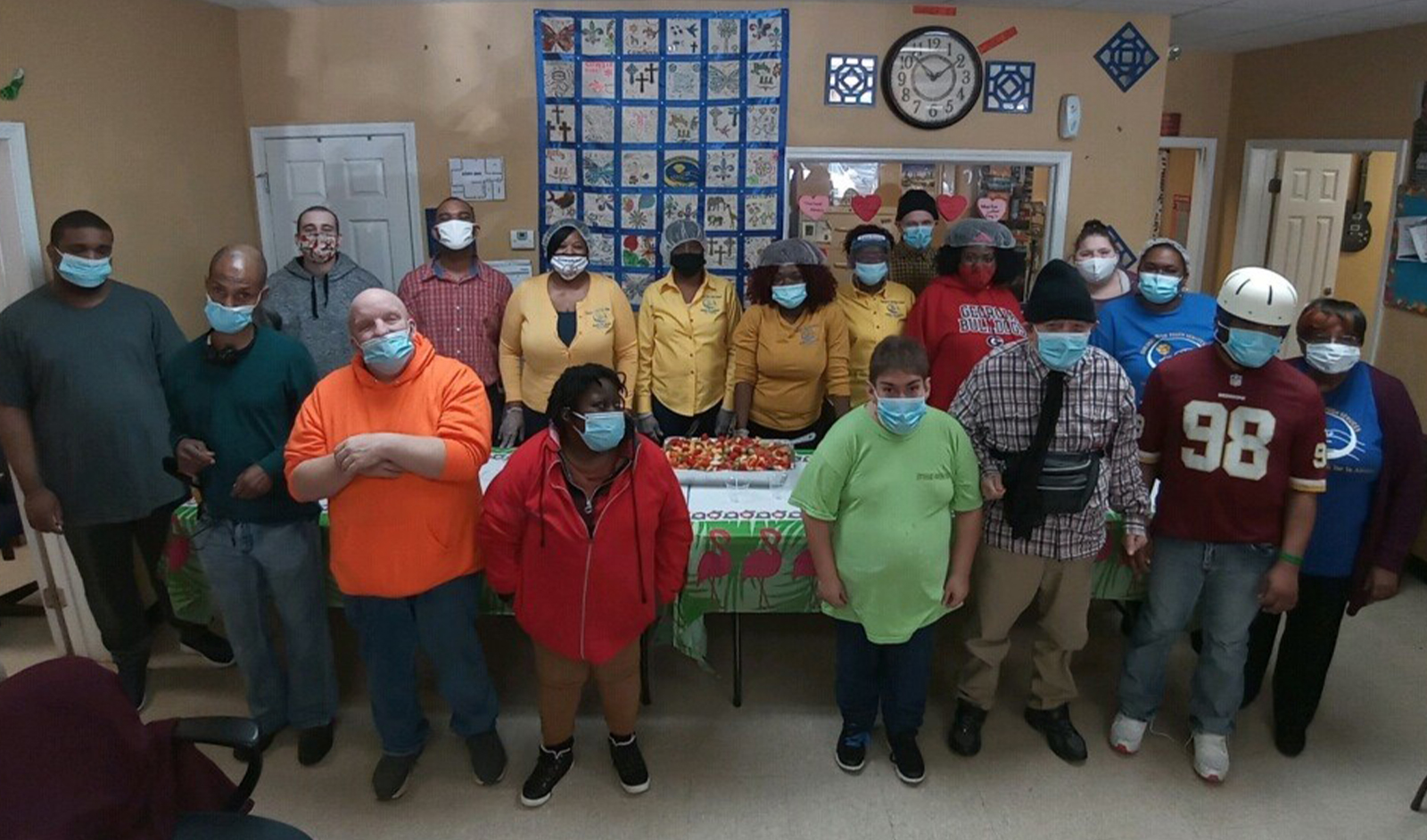
Holidays are acknowledged by hosting special luncheons and parties, with participants preparing for the occasions by helping to decorate, creating the perfect ambiance for the occasion. They also dress up in semi-formal attire and take pictures. A nutritious and delicious lunch is served, incorporating fresh fruits and leafy green salads. Parents, providers and other core team members are invited and always welcomed to the Diamond Center.
“It warms my heart to see them dancing, laughing and having fun. Engaging and interacting with them results in everyone having a good time,” added Jones.
The goal at the Diamond Center Adult Day Program is for individuals to proceed to a higher level than their initial admission. It is very important to encourage healthy living, healthy diet and to engage individuals in ISP goals and community integration. The Diamond Center continuously strives to lead by example regarding principles of nutrition, encouraging healthier choices in every aspect of life and will continue to provide support looking at individuals as a whole.
In Rex, Georgia, the Diamond Center Adult Day Program has been a CACFP participant through Georgia Nutritional Services, Inc. since 2014.