Upholding program integrity in the CACFP strengthens trust, safeguards resources and ensures the food program continues to nourish communities nationwide. Program compliance is important not only for sponsoring organizations but also for State agencies and program sites.
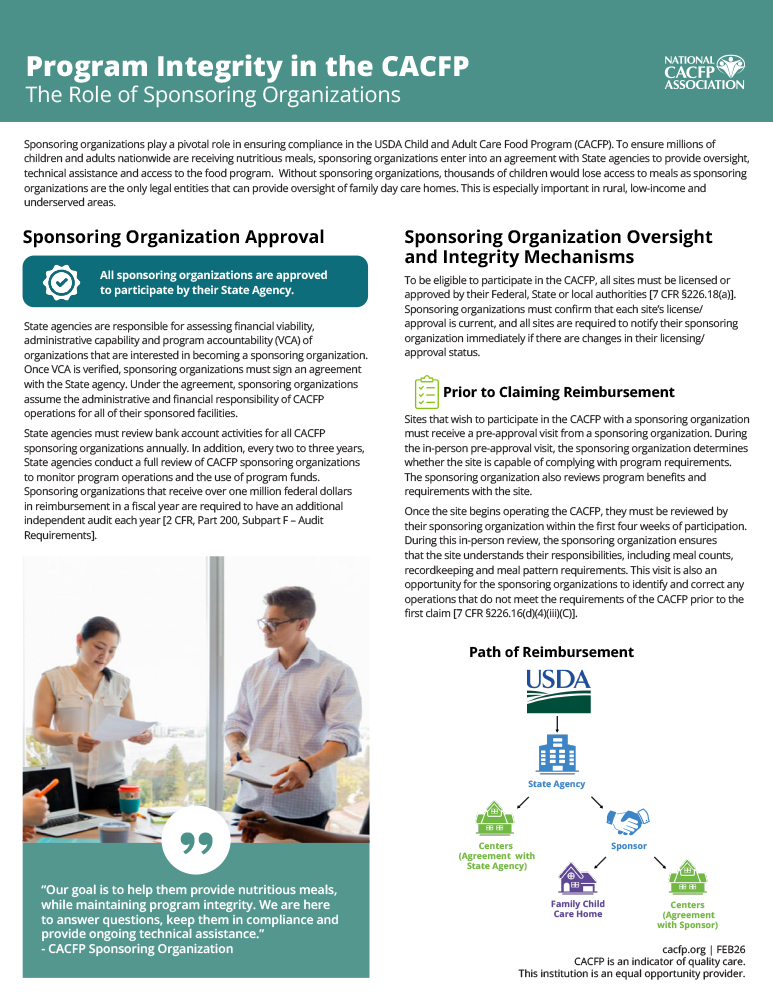
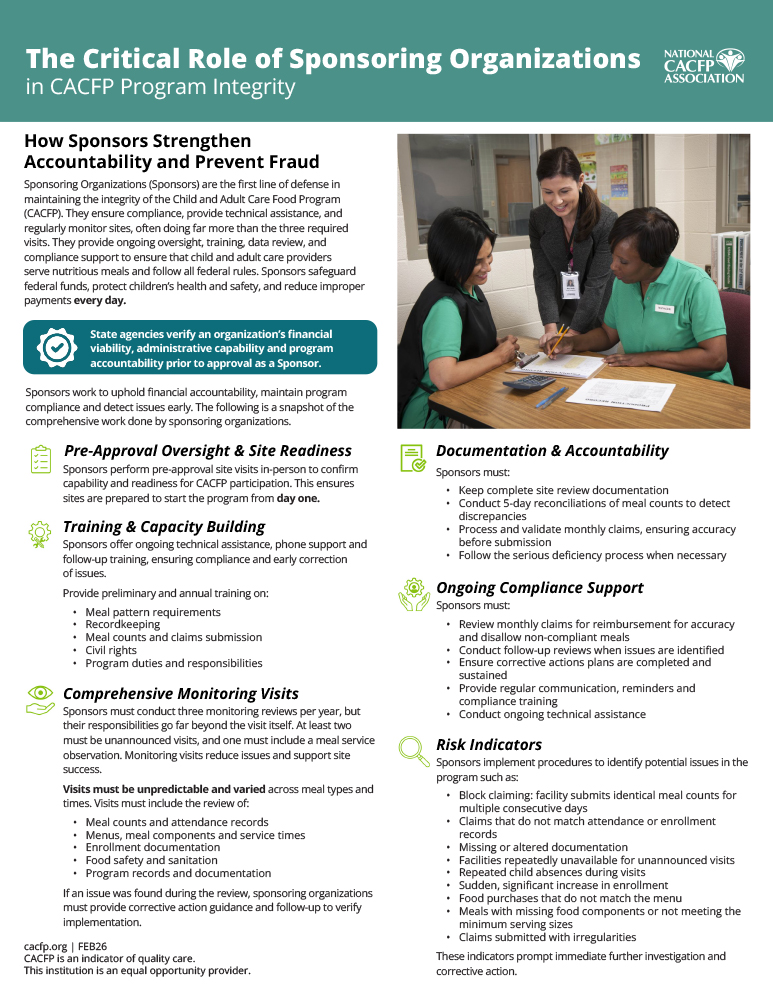
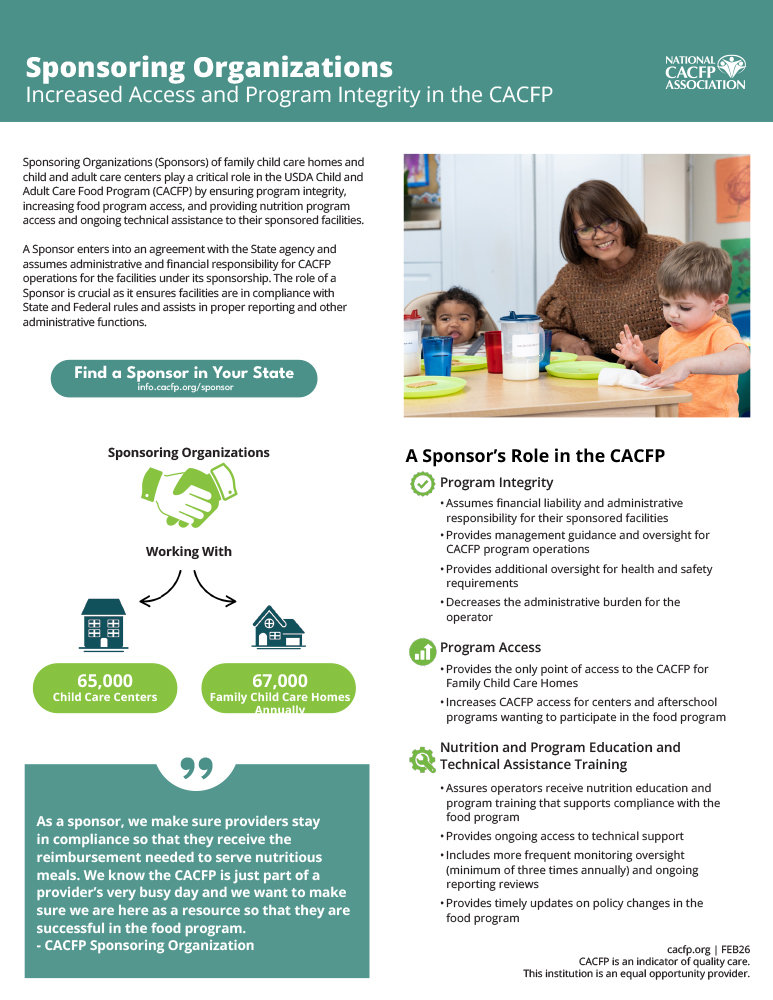
Program Integrity in the CACFP: The Role of Sponsoring Organizations
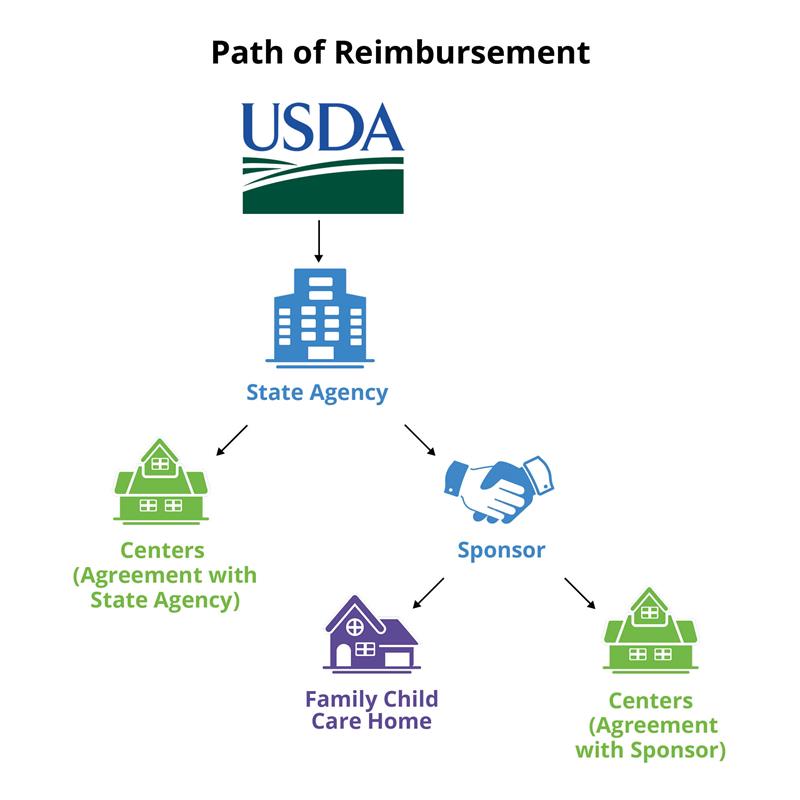
Sponsoring organizations play a pivotal role in ensuring compliance in the USDA Child and Adult Care Food Program (CACFP). To ensure millions of children and adults nationwide are receiving nutritious meals, sponsoring organizations enter into an agreement with State agencies to provide oversight, technical assistance and access to the food program. Without sponsoring organizations, thousands of children would lose access to meals as sponsoring organizations are the only legal entities that can provide oversight of family day care homes. This is especially important in rural, low-income and underserved areas.
How are sponsoring organizations approved to participate in CACFP?
All sponsoring organizations are approved to participate by their State Agency.
State agencies are responsible for assessing financial viability, administrative capability and program accountability (VCA) of organizations that are interested in becoming a sponsoring organization. Once VCA is verified, sponsoring organizations must sign an agreement with the State agency. Under the agreement, sponsoring organizations assume the administrative and financial responsibility of CACFP operations for all of their sponsored facilities.
State agencies must review bank account activities for all CACFP sponsoring organizations annually. In addition, every two to three years, State agencies conduct a full review of CACFP sponsoring organizations to monitor program operations and the use of program funds. Sponsoring organizations that receive over one million federal dollars in reimbursement in a fiscal year are required to have an additional independent audit each year [2 CFR, Part 200, Subpart F – Audit Requirements].
How do sponsoring organizations maintain program integrity?
To be eligible to participate in the CACFP, all sites must be licensed or approved by their Federal, State or local authorities [7 CFR §226.18(a)]. Sponsoring organizations must confirm that each site's license/approval is current, and all sites are required to notify their sponsoring organization immediately if there are changes in their licensing/approval status.
What happens before a site can claim reimbursement?
Sites that wish to participate in the CACFP with a sponsoring organization must receive a pre-approval visit from a sponsoring organization. During the in-person pre-approval visit, the sponsoring organization determines whether the site is capable of complying with program requirements. The sponsoring organization also reviews program benefits and requirements with the site.
Once the site begins operating the CACFP, they must be reviewed by their sponsoring organization within the first four weeks of participation. During this in-person review, the sponsoring organization ensures that the site understands their responsibilities, including meal counts, recordkeeping and meal pattern requirements. This visit is also an opportunity for the sponsoring organizations to identify and correct any operations that do not meet the requirements of the CACFP prior to the first claim [7 CFR §226.16(d)(4)(iii)(C)].
What monitoring visits are required in CACFP?
Each program year, sponsoring organizations must visit every sponsored site at least three times. Of those three visits, two are required to be unannounced, meaning the site does not know that the sponsoring organization will be visiting them that day and has no opportunity to prepare in advance of the visit. In addition, sponsoring organizations must vary the timing of their visits so that they do not follow a predictable pattern, and no more than six months can pass between reviews. If there are any issues during a review, sponsoring organizations must follow up with the site promptly to ensure issues are corrected.
At every review, the sponsoring organization must check that the site meets licensing/approval requirements, has attended an annual CACFP and Civil Rights training, has up to date enrollment forms, has a menu posted, and has meal count and attendance records [7 CFR §226.16(d)(4)(i)]. These records must be kept on hand by the site for three years.
During each review, the sponsoring organization must also conduct a five-day reconciliation that compares meal counts with enrollment and attendance records for five consecutive days during the current or previous month. In addition, the sponsoring organization must confirm that any issues, if noted during previous reviews, have been corrected.
At least one of the unannounced reviews must also include a meal service observation; however, most sponsoring organizations conduct all of their visits at the time of a meal service. During the meal service, the sponsoring organization observes whether the food served aligns with the menu posted by the site for that day and that any food substitutions are documented. They also check that meals and portion sizes meet the meal pattern requirements and that health and safety standards are met.
If there are issues identified during the visit or discrepancies in the five-day reconciliation, sponsoring organizations may reach out to household contacts. The parent or guardian of a child can verify the attendance and enrollment of their child and confirm the specific meal service(s) that the child typically receives in care [7 CFR §226.16(d)(5)].
"Our goal is to help them provide nutritious meals, while maintaining program integrity. We are here to answer questions, keep them in compliance and provide ongoing technical assistance."
- CACFP Sponsoring Organization
How do sponsoring organizations maintain ongoing compliance?
Sponsoring organizations often implement oversight mechanisms that exceed regulatory requirements.
Maintaining program compliance requires ongoing oversight of food program sites. There are many procedures in place for sponsoring organizations to regularly check that their sites are operating in compliance with program requirements.
- Sites must obtain enrollment forms signed by a parent/guardian for all children in their care. Enrollment forms are submitted to sponsoring organizations and are used to ensure that sites are not claiming children who do not exist or are not enrolled. Sites are also required to maintain daily attendance records.
- Sites are required to submit daily meal counts that identify the number of meals served to enrolled children for each meal service. Sites are not allowed to count more than two meals and one snack per child on any given day [7 CFR §226.18(c)].
- Sites must post a CACFP-compliant menu, including all food items that will be served and any substitutions that are made, for parents and guardians to see. In addition, sites must maintain proper meal pattern documentation to prove that the meals they serve are compliant with CACFP regulations. Centers must provide receipts to verify that enough food was purchased for the number of meals claimed and to ensure the food purchased aligns with the posted menu.
- Meal counts are recorded daily by participating sites and reimbursed by the sponsoring organization on a monthly schedule. Sponsoring organizations conduct thorough reviews of claims and disallow any meals that do not meet compliance standards. Claims are then submitted to the State agency for approval before reimbursement is released to sponsoring organizations.
- Sponsoring organizations will conduct additional visits and virtual check-ins outside of the three required monitoring visits, both to provide technical assistance and to confirm program compliance. They are regularly checking for any issues that may be signals of program non-compliance or improper claims.
What indicators would prompt a sponsoring organization to perform additional reviews of sites?
Sponsors implement procedures to identify potential issues in the program such as:
- Block claiming: facility submits identical meal counts for multiple consecutive days
- Claims that do not match attendance or enrollment records
- Missing or altered documentation
- Facilities repeatedly unavailable for unannounced visits
- Repeated child absences during visits
- Sudden, significant increase in enrollment
- Food purchases that do not match the menu
- Meals with missing food components or not meeting the minimum serving sizes
- Claims submitted with irregularities
These indicators prompt immediate further investigation and corrective action.
How do sponsoring organizations address instances of serious program mismanagement or repeated program non-compliance?
The serious deficiency process is a mechanism available to State agencies and sponsoring organizations to address instances of serious program mismanagement or repeated program non-compliance. Through the process, State agencies and sponsoring organizations have the ability to terminate sites that are not in compliance with Federal regulations. In addition, organizations and responsible individuals found seriously deficient are placed on a National Disqualified List and are unable to participate in the CACFP for seven years or until any outstanding debt is repaid, whichever is longer.