
State Policies Shaping the Future of CACFP
May 28, 2026

The Child and Adult Care Food Program (CACFP) is a federally funded and administered nutrition program that plays a critical role in supporting the health and well-being of children and adults in care settings across the country. While federal reimbursements establish the program’s foundation, they often fall short of covering the full cost of administering CACFP and meeting the real-world needs of operators on the ground. States are uniquely positioned to step up where federal funding falls short and address the needs of their communities. Multiple states have already taken up this mantle and pushed forward policies to better support providers and sponsors of the CACFP in successfully operating the program.
Supplemental Reimbursement
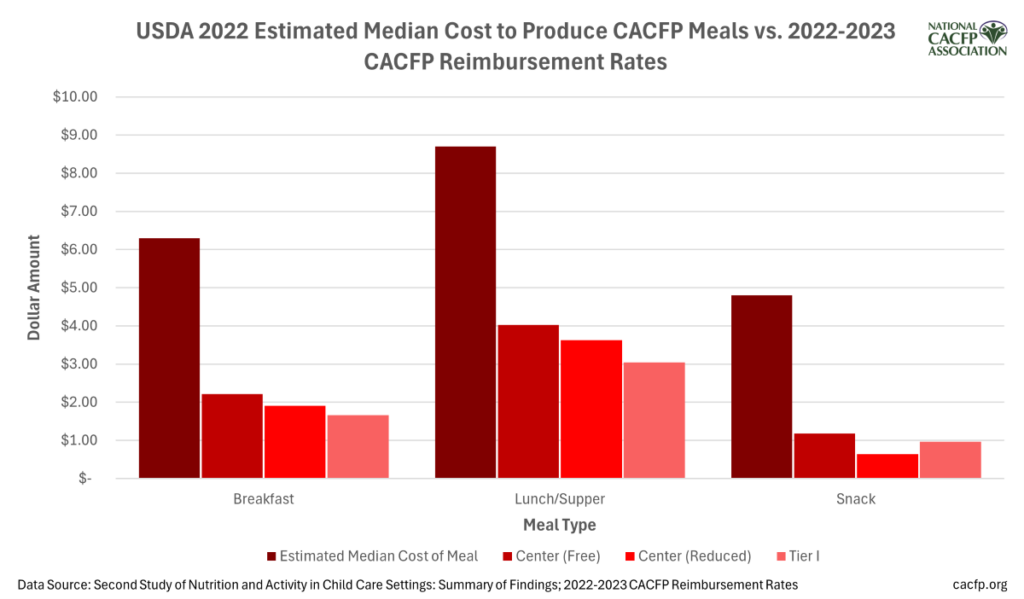
While federal reimbursements are crucial for CACFP operators to provide nutritious meals and reduce costs to families, the rates of reimbursement do not come near to covering the true cost of providing a meal.
Based on an estimate from the United States Department of Agriculture (USDA) reimbursement rates only covered 26% of total breakfast costs, 35% of total lunch costs, and 21% of total snack costs for centers. The total cost of a meal includes the cost of food and labor needed to prepare and serve the meal. In the study, USDA estimated that the mean total cost per meal in child care centers was $8.80 for breakfast, $9.70 for lunch, and $6.30 for snack. However, this estimate was done in 2022-2023 and we have seen food and labor prices continue to rise since then, meaning the mean cost to provide a meal today is likely higher than USDA’s 2022-2023 estimates. While reimbursement rates have also increased annually, they continue to fall significantly short of what providers need to fully cover the cost of meals.
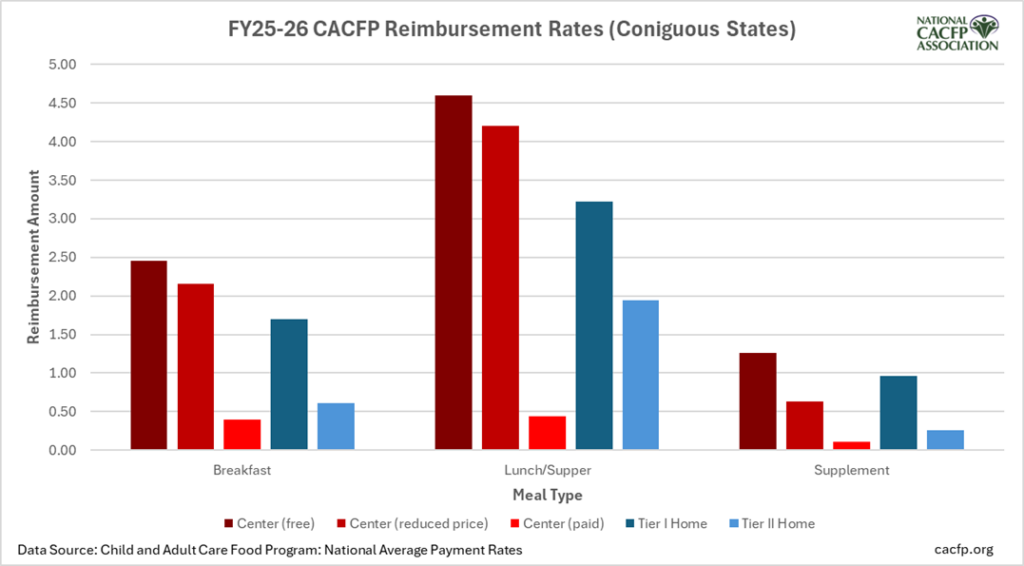
The USDA study does not estimate the cost to provide meals in family child care homes, but it is fair to assume that the cost to provide meals in family child care homes is similar to that of centers. While centers may have to pay for additional labor to provide a higher quantity of meals, they are able to buy larger bulk items that decrease their costs. On the other hand, family child care homes are purchasing smaller items at their neighborhood grocery store, which cost more per child. Family homes receive reimbursement based on a Tiered system that is determined by the income levels of the area in which they live. Tier I, the higher level of reimbursement, has a rate that is less than that for reduced-price meals in centers. Tier II homes receive half the amount of reimbursement of their Tier I counterparts. The reimbursement rates are not adequate for either Tier of family home to cover the full cost of meals, but the financial gap is even greater for Tier II homes, which are providing the same quality of meals, often shopping at the same grocery stores, and serving the same community.
In addition to the inadequate levels of reimbursement, operators are also limited in the number of meals/snacks they can serve. Through the CACFP operators can be reimbursed for up to two meals and one snack each day (ex. Breakfast, Lunch, Afternoon Snack). However, the child care landscape has evolved drastically since this policy was created. Children are often in care for full 8-hour days, with most children in CACFP care for 39-43 hours per week (SNACS-II). As a result, providers often serve the children an extra meal or snack to ensure they are not hungry while in care. However, the cost of those extra meals must come out of the pocket of the child care provider themselves or be included in the cost of care. Although providers are responding to the dietary needs of the children they care for, they are not reimbursed for all of the meals they provide.
Some states have recognized these disparities and have pushed policies through their legislature to help lessen the financial gap. DC was the first to pass comprehensive legislation to provide additional financial support the CACFP operators. The Healthy Tots act was passed in 2014, which included provisions to lessen the financial burden on providers. Through the act, DC provides an additional $0.10 for every creditable breakfast, lunch and supper served to infants and children through the CACFP. DC also provides full reimbursement for an additional meal or snack to CACFP child care providers who are already serving the maximum number of federally reimbursable meals. The Healthy Tots Act also includes a third provision providing an additional $0.05 reimbursement for each lunch or supper that contains at least one locally grown component.
California is another state that has stepped up to cover the financial gap left after federal reimbursement. In a 2021 Budget Bill, California implemented a $0.2160 supplemental reimbursement for Breakfasts and Lunches. Child care centers directly receive this reimbursement for every creditable Breakfast and Lunch they serve. On the other hand, family child care homes receive supplemental reimbursement for 75% of the Breakfasts and Lunches they serve.
In 2023, in a larger child care package, Vermont was able to provide additional reimbursement for Tier II CACFP homes. In program year 2025-2026, Vermont was been able to provide state-level funds to Tier II providers that ensure they receive the same level of reimbursement as Tier I providers.
Sponsor Administrative Funds
Sponsoring organizations play a critical role in the CACFP by ensuring program integrity, increasing food program access, and providing ongoing technical assistance to their sponsored facilities. Despite their importance, there has been an ongoing decline in the number of organizations sponsoring the CACFP due to the administrative burden and financial risk of operating as a sponsor. State agencies have struggled to keep sponsoring organizations on the program, and recruit new sponsoring organizations, because the federal administrative funds for sponsoring organizations are not enough to cover their CACFP operational costs.
In a 2024 report from the National CACFP Association, 40% of sponsoring organizations said that the administrative funds they receive do not cover their CACFP expenses. The other 60% of sponsoring organizations report operating on slim margins. As the cost of administering the program continues to increase, it is becoming more difficult for sponsoring organizations to cover their costs and raise sufficient funds.
Sponsoring organizations also stated that insufficient administrative funds force them to keep wages low. Half of sponsoring organizations shared that they are operating without a full staff because they cannot hire at such low wages, noting that they are forced to offer lower pay than what an applicant could receive at a fast-food restaurant. The complexity of the program makes it difficult to employ qualified staff with limited funding. Some have even had to cut back on staff because the administrative rate does not allow them to cover the minimum wage required in their state.
In response, some states have stepped in to provide additional financial support for sponsoring organizations. In 2024, Oregon legislators passed a bill that provided $660,000 to the Oregon Department of Education (ODE) for family child care home sponsors. Using this money, ODE created two grant opportunities to help mitigate the loss of existing sponsors in Oregon and help to recruit new sponsors. Through the grant, ODE provides $120,000 to new sponsoring organizations for their first year of operations and $50,000 per year for returning sponsoring organizations.
Vermont was also able to secure administrative funds for its sponsoring organizations for Fiscal Year 2026. The Vermont legislature allocated $150,000 is one-time funding to the Vermont Agency of Education. The agency then distributed the funds to each sponsoring organization proportionate to the number of family child care homes they sponsored. Advocates are actively working to secure $182,000 in FY27 appropriations that would also allow for a new sponsor to come on board.
Child Care Investment
The number of family child care homes participating in the CACFP has declined by 24% between 2019 and 2024. While this decline in participation is multifaceted, part of the decline can be attributed to the closure of family child care businesses. As CACFP is innately tied to child care, investments in child care can have a positive impact on the CACFP as well.
In 2025, Massachusetts implemented a series of child care initiatives to bolster affordability and access for families in the state. Part of their investment included $2.7 million for the Family Child Care Capital Grant Program. These dollars are distributed as grants ranging from $500 to $25,000 to help family child care providers expand and improve their programs. As a result of this investment, Massachusetts has seen an increase in the supply of family child care home businesses in the state. This has also resulted in an increase in the number of family homes participating in the CACFP in Massachusetts. In contrast to every other state, Massachusetts is the only one to have seen and increase in the number of homes participating in CACFP between 2019 and 2024, and at a rate (24%) that is the exact opposite of the national trend (-24%).
As federal resources remain limited and program demands continue to grow, state leadership will play an increasingly important role in determining the strength and sustainability of CACFP. By investing state funds, streamlining administration and expanding outreach, states can reduce barriers for providers and ensure participants receive the full benefits of the program. The examples highlighted in this brief demonstrate that when states step in to complement federal support, CACFP becomes more resilient, equitable, and responsive to operator needs.