
Culinary Math
Institute of Child Nutrition
April 23, 2026

Whether you’re making a snack for six children or lunch for sixty, good culinary math skills are essential and make cooking easier, more accurate, and less stressful. This Mealtime Memo from our partners at ICN explains how to convert recipes and adjust ingredient amounts to keep your food consistent and accurate every time.
Why Culinary Math Matters
You may not think about math when you put on your apron, but it’s part of every task in the kitchen. From doubling a recipe to measuring ingredients accurately, culinary math is essential to a successful kitchen. Practicing this skill ensures every serving meets meal requirements.
Recipe Too Big? Too Small? Scale it!
Ever found a great recipe, but it makes 50 servings when you only need 10? No problem! You can adjust the recipe using a few easy calculations known as the factor method.
What’s the Factor Method?
This is a simple two-step way to make a recipe bigger or smaller, so you get the correct number of servings:
- Step 1: Find the Scaling Factor
Divide the number of servings you need by the number of servings the recipe makes.
- Step 2: Multiply Each Ingredient by the Factor
Multiply each amount in the recipe by the scaling factor.
Example: Scaling Up
You need 25 servings, but the recipe makes 6.
- Step 1: 25 ÷ 6 = 4.16 (this is your factor)
- Step 2: Multiply each ingredient by 4.16
- Ex: 1 pound (Ib) chicken x 4.16 = 4.16 Ibs (round up to 4.25 pounds or 4 Ib 4 oz)
Example: Scaling Down
You need 6 servings, but the recipe makes 25.
- Step 1: 6 ÷ 25 = 0.24 (factor)
- Step 2: Multiply each ingredient by 0.24.
- Ex: 3 cups of milk x 0.24 = 0.72 Cups (round up to ¾ cup)
Make All Ingredients the Same Unit
Once you’ve calculated the factor, make sure your ingredient amounts use the same unit before multiplying.
- For example: 5 lb 8 oz equals 5.5 pounds (16 oz in a pound—8 oz is half a pound)
Using the same unit makes it much easier to adjust the recipe.
Smart Measuring Means Less Guessing
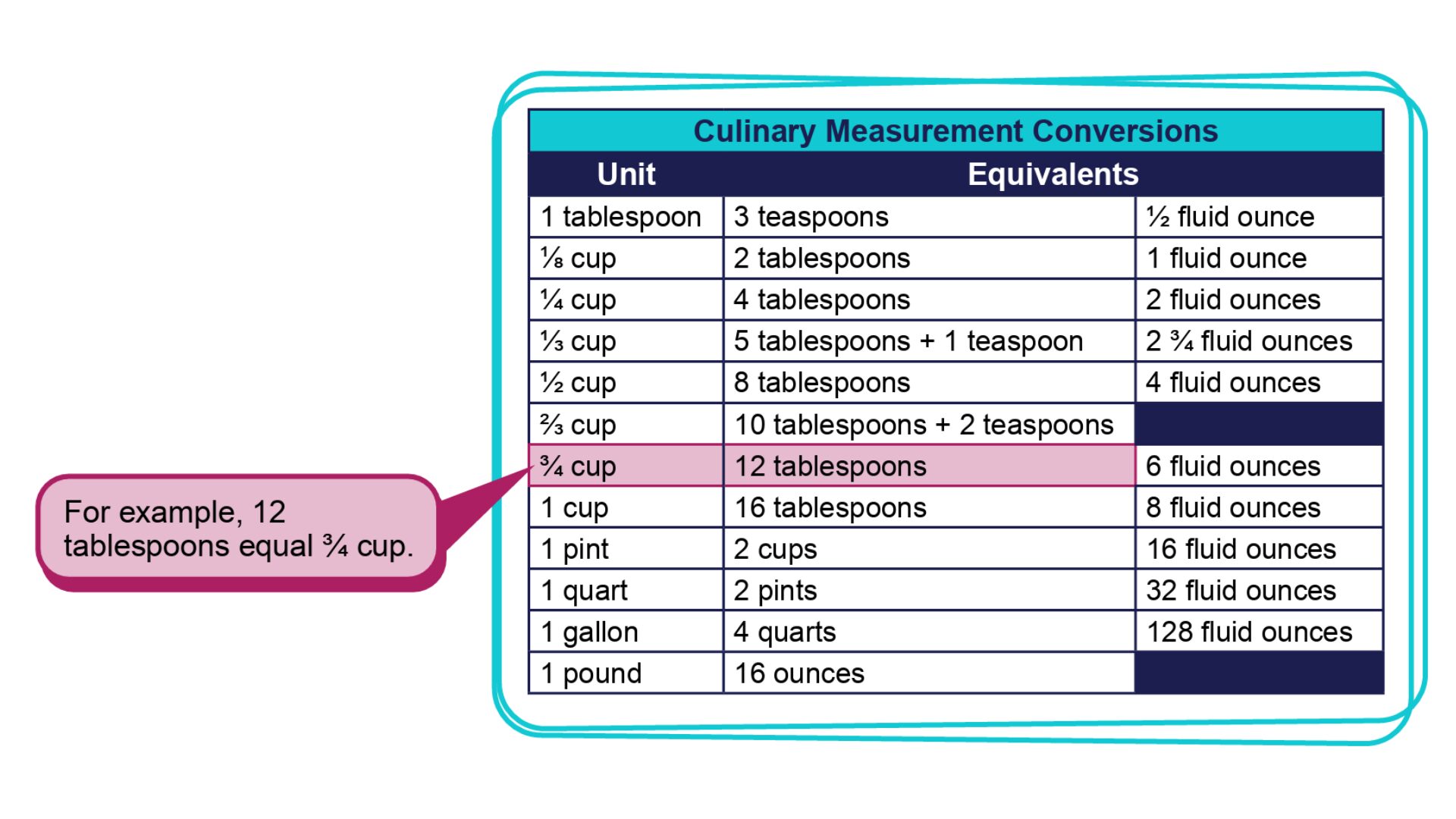
After you adjust a recipe, you might end up with an amount that takes many small measurements.
Choose the measuring tool that gets you closest to the amount with the least effort.
Fewer scoops mean fewer mistakes!
The Culinary Measurement Conversions chart has common conversions. Both resources below include conversion charts.
Culinary math doesn’t have to be hard. With a few simple tricks and some practice, you can adjust recipes and convert measurements with confidence. Don’t let tricky serving sizes stop you from using your favorite recipes—convert, scale, and serve with accuracy!
For more tips and resources, read ICN’s April Mealtime Memo.