NCA Response – National Disqualified List Information Collection
August 5, 2026
In June 2026, USDA released a notice of Agency Information Collection Activities: Child and Adult Care Food Program (CACFP) National Disqualified List. This notice is of a routine collection of information, where State agencies share information on organizations and individuals who have been found seriously deficient so USDA can place them on the National Disqualified List (NDL).
Although this is a routine information collection, NCA provided comments to enhance the quality of information collected. NCA recommended that USDA collect information on the specific findings that resulted in the serious deficiency determinations in order to inform an analysis of the implementation of the Serious Deficiency Process across states. NCA also suggested that USDA collect information on State agency Early Removal Processes to inform the development of a federal process.
NCA Comment on Agency Information Collection Activities: Child and Adult Care Food Program (CACFP) National Disqualified List
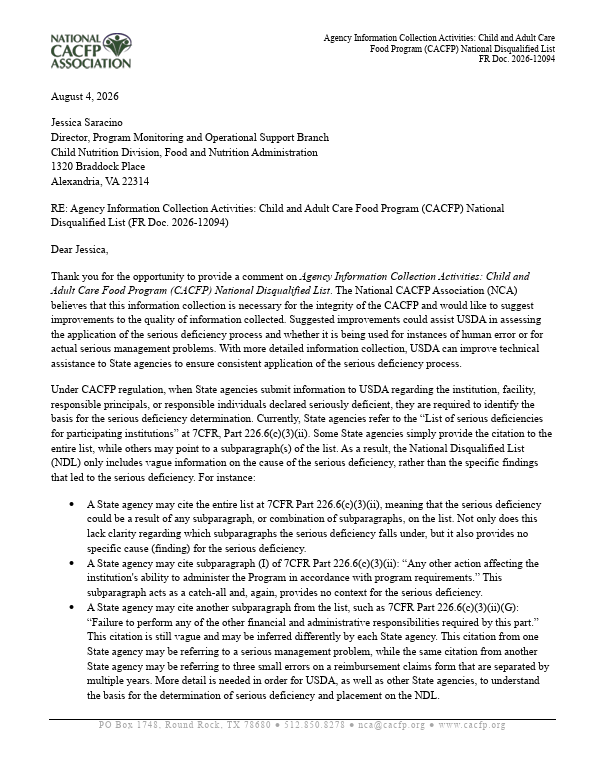
Thank you for the opportunity to provide a comment on Agency Information Collection Activities: Child and Adult Care Food Program (CACFP) National Disqualified List. The National CACFP Association (NCA) believes that this information collection is necessary for the integrity of the CACFP and would like to suggest improvements to the quality of information collected. Suggested improvements could assist USDA in assessing the application of the serious deficiency process and whether it is being used for instances of human error or for actual serious management problems. With more detailed information collection, USDA can improve technical assistance to State agencies to ensure consistent application of the serious deficiency process.
Enhanced Information Collection
Under CACFP regulation, when State agencies submit information to USDA regarding the institution, facility, responsible principals, or responsible individuals declared seriously deficient, they are required to identify the basis for the serious deficiency determination. Currently, State agencies refer to the “List of serious deficiencies for participating institutions” at 7CFR, Part 226.6(c)(3)(ii). Some State agencies simply provide the citation to the entire list, while others may point to a subparagraph(s) of the list. As a result, the National Disqualified List (NDL) only includes vague information on the cause of the serious deficiency, rather than the specific findings that led to the serious deficiency. For instance:
- A State agency may cite the entire list at 7CFR Part 226.6(c)(3)(ii), meaning that the serious deficiency could be a result of any subparagraph, or combination of subparagraphs, on the list. Not only does this lack clarity regarding which subparagraphs the serious deficiency falls under, but it also provides no specific cause (finding) for the serious deficiency.
- A State agency may cite subparagraph (I) of 7CFR Part 226.6(c)(3)(ii): “Any other action affecting the institution's ability to administer the Program in accordance with program requirements.” This subparagraph acts as a catch-all and, again, provides no context for the serious deficiency.
- A State agency may cite another subparagraph from the list, such as 7CFR Part 226.6(c)(3)(ii)(G): “Failure to perform any of the other financial and administrative responsibilities required by this part.” This citation is still vague and may be inferred differently by each State agency. This citation from one State agency may be referring to a serious management problem, while the same citation from another State agency may be referring to three small errors on a reimbursement claims form that are separated by multiple years. More detail is needed in order for USDA, as well as other State agencies, to understand the basis for the determination of serious deficiency and placement on the NDL.
In order to ensure that the NDL provides clear, quality information regarding the context of serious deficiency determinations, USDA should collect more detailed information from State agencies during its’ information collection activities. In addition to collecting the CFR citation, USDA should collect specific findings from the State agency that led to the serious deficiency. These findings should be included in the NDL listing for the institution, facility, responsible principals, or responsible individuals.
Serious Deficiency Process Evaluation
In 2024, NCA commented on the Proposed Rule: Serious Deficiency Process in the CACFP and SFSP (FNS-2024-0005-0001), recommending that USDA conduct an analysis of State Agency Lists and the National Disqualified List to determine the types of findings that have resulted in the application of the current serious deficiency process, as well as disqualification from the CACFP. However, without the collection of more detailed information from USDA, an impactful analysis is not possible. This enhanced information collection could assist USDA, State agencies and Sponsors in evaluating the implementation of the serious deficiency process, variations in implementation across State agencies, and the type and severity of findings that have been raised to the level of a serious deficiency by State agencies.
Early Removal Process
Also included in NCA’s comment on the proposed rule, NCA requested that USDA establish a specific process for State agencies to implement for early removal from the NDL. The Serious Deficiency, Suspension, & Appeals for State Agencies and Sponsoring Organizations Handbook states that institutions, facilities, and individuals may submit a request to their State agency to be removed from the NDL early if they have submitted corrective action and paid any debts owed. However, it is up to the discretion of the State agency to implement any procedures for early removal. Therefore, State agencies without an early removal procedure can deny any request for early removal. To evaluate the implementation of early removal procedures across State agencies, NCA recommends that USDA collect information on early removal during its information collection activities. By doing so, USDA can examine current early removal processes that could help inform the creation of a federal standard.
Contact policy@cacfp.org with any questions.